SkyTrain for Surrey

How Fast Can SkyTrain to Newton Be Built? Lessons from Three Past SkyTrain Projects

Since the provincial Conservative government announced its intention to extend SkyTrain from Surrey City Centre to Newton, a familiar narrative has emerged. Pundits and skeptics are already claiming Surrey residents shouldn’t expect to ride a train to Newton for ten years, fifteen years, or perhaps ever. Others are using this uncertainty to revive calls for Bus Rapid Transit (BRT) or at-grade Light Rail Transit (LRT).

At SkyTrain for Surrey, we believe it is important to separate facts from speculation—and what we can do is look at history.

When rapid transit projects have become government priorities in British Columbia, they have often advanced far more quickly than many people remember. Metro Vancouver’s own SkyTrain network contains several examples where major extensions moved from political commitment to passenger service in substantially less than a decade.

Here is what history actually tells us about how fast SkyTrain can be built.

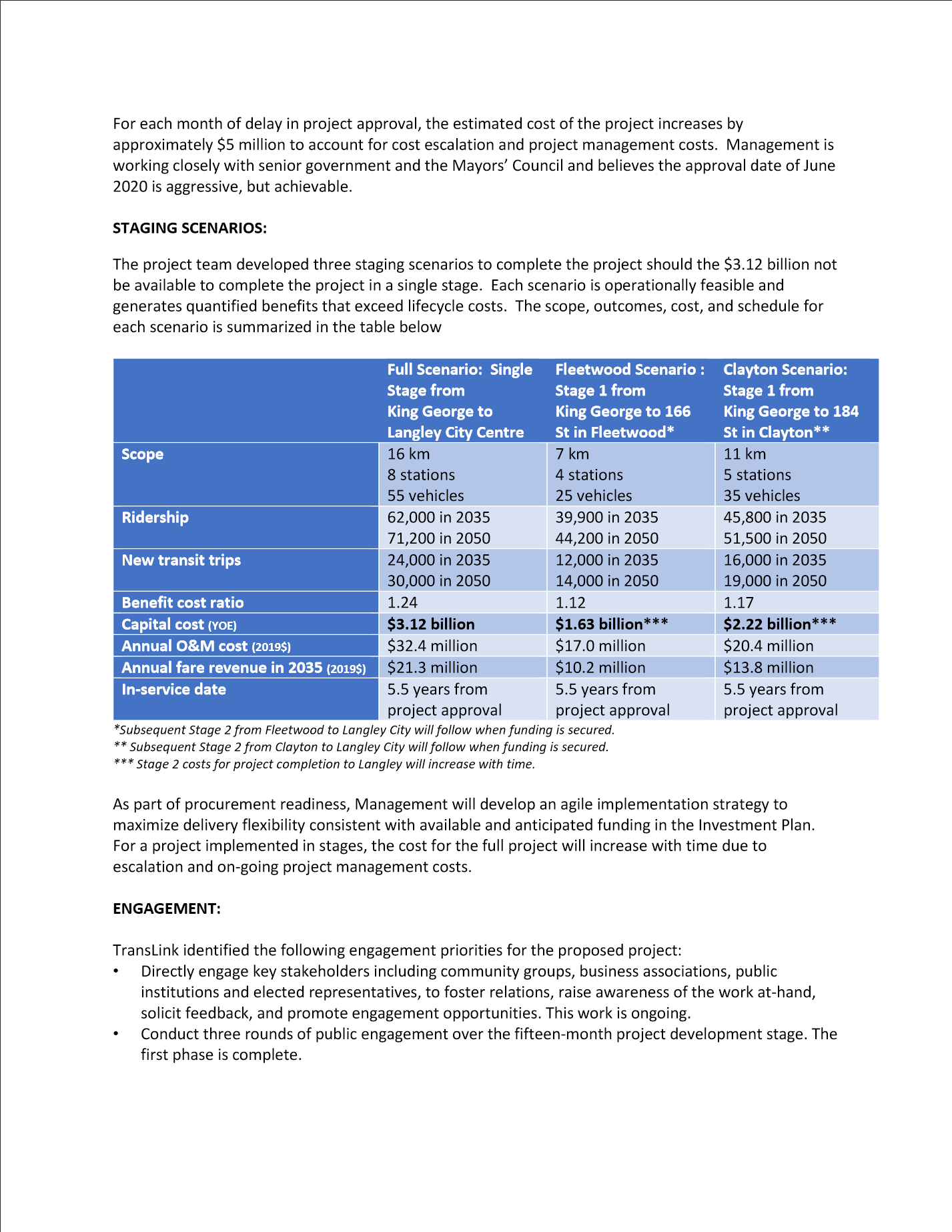
1. Surrey Langley SkyTrain - 7 years to develop and build 16km

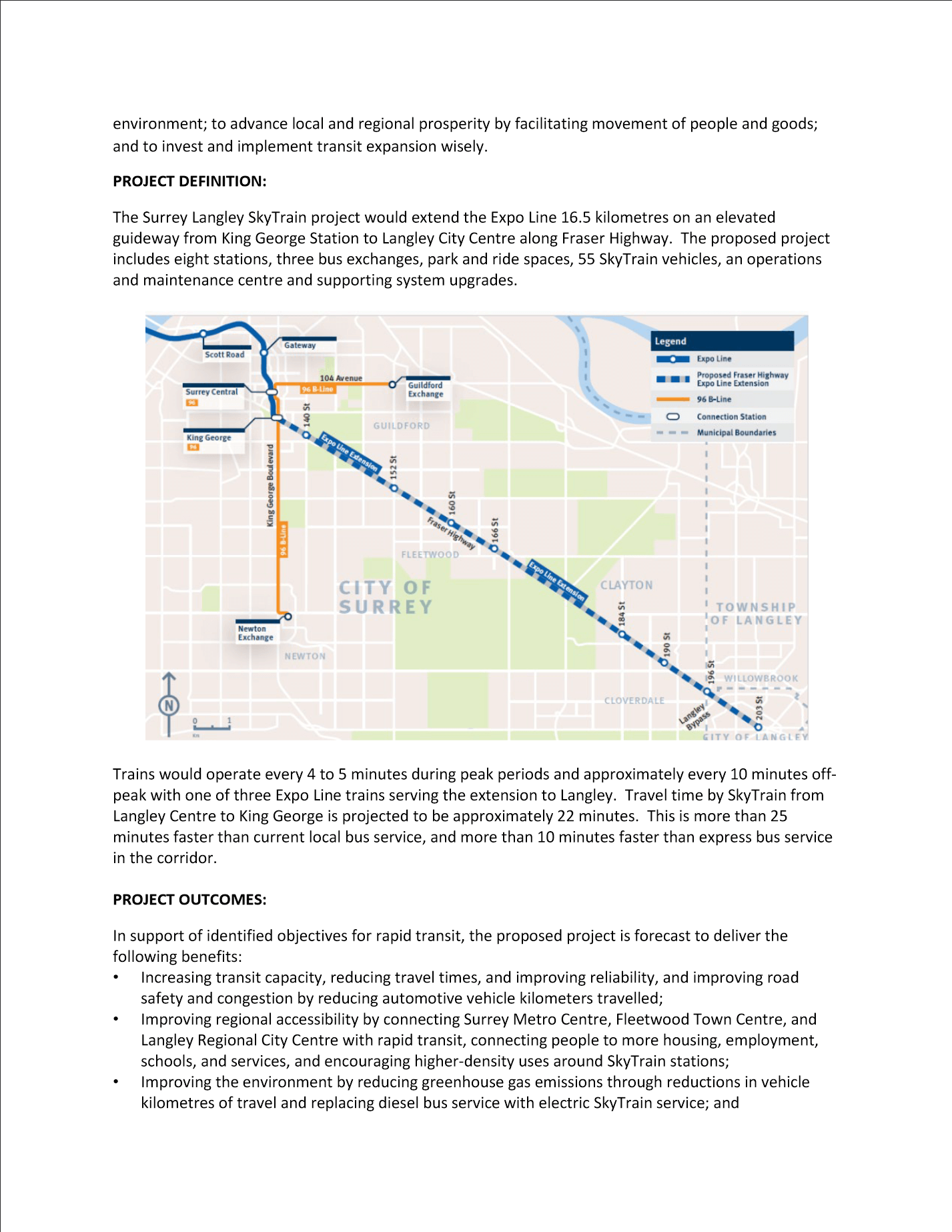
The clearest blueprint for a Newton extension is the SkyTrain project currently under construction down Fraser Highway.

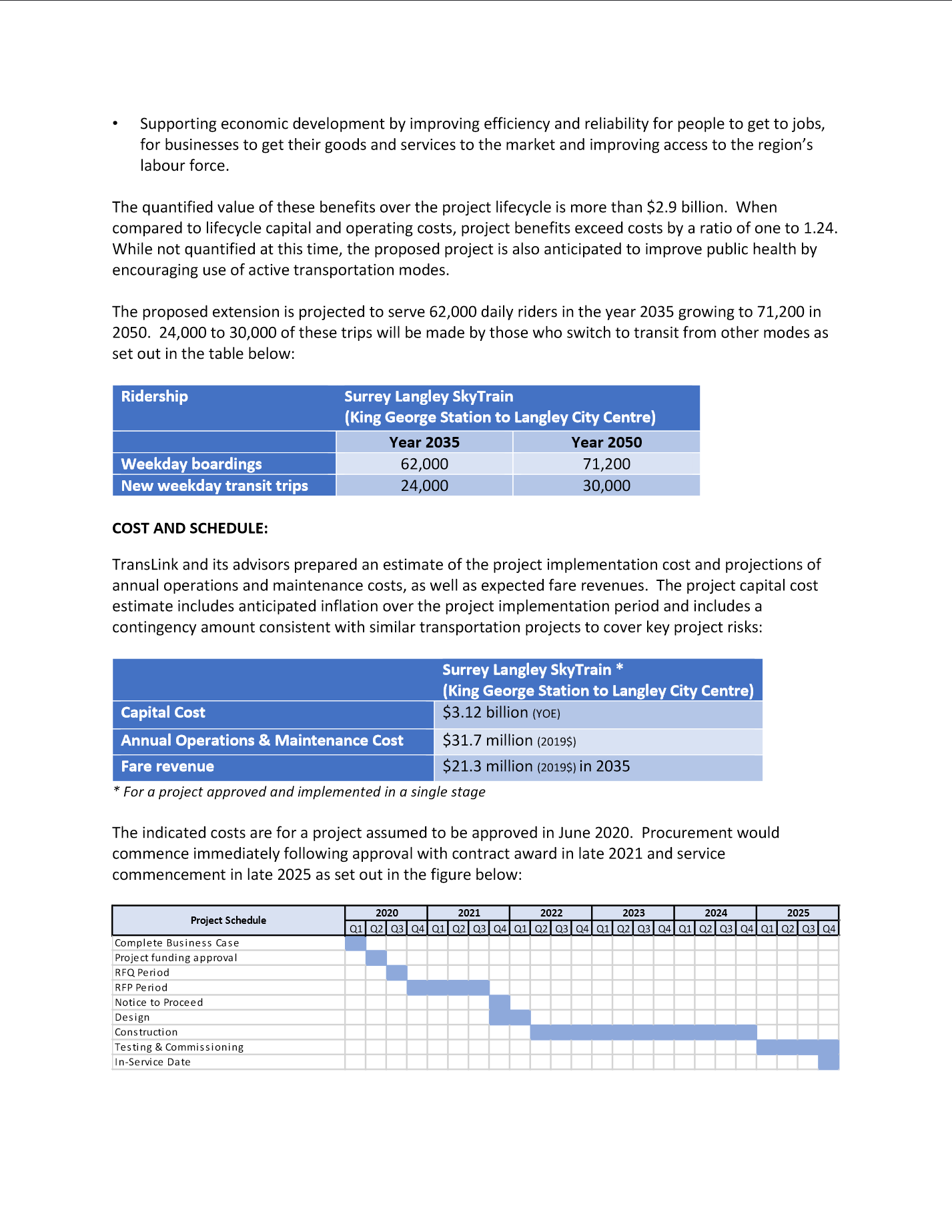
Before the COVID-19 pandemic disrupted global supply chains, the Surrey Langley SkyTrain (SLS) was on track to open by late 2025—just seven years after initial approval.

While pandemic-era inflation and labour shortages eventually pushed completion to 2028 (and now 2029), the original pre-pandemic schedule remains a textbook example of how rapidly a SkyTrain project can advance when funding, governance, and political will align.

TransLink gave clear timelines for development and construction

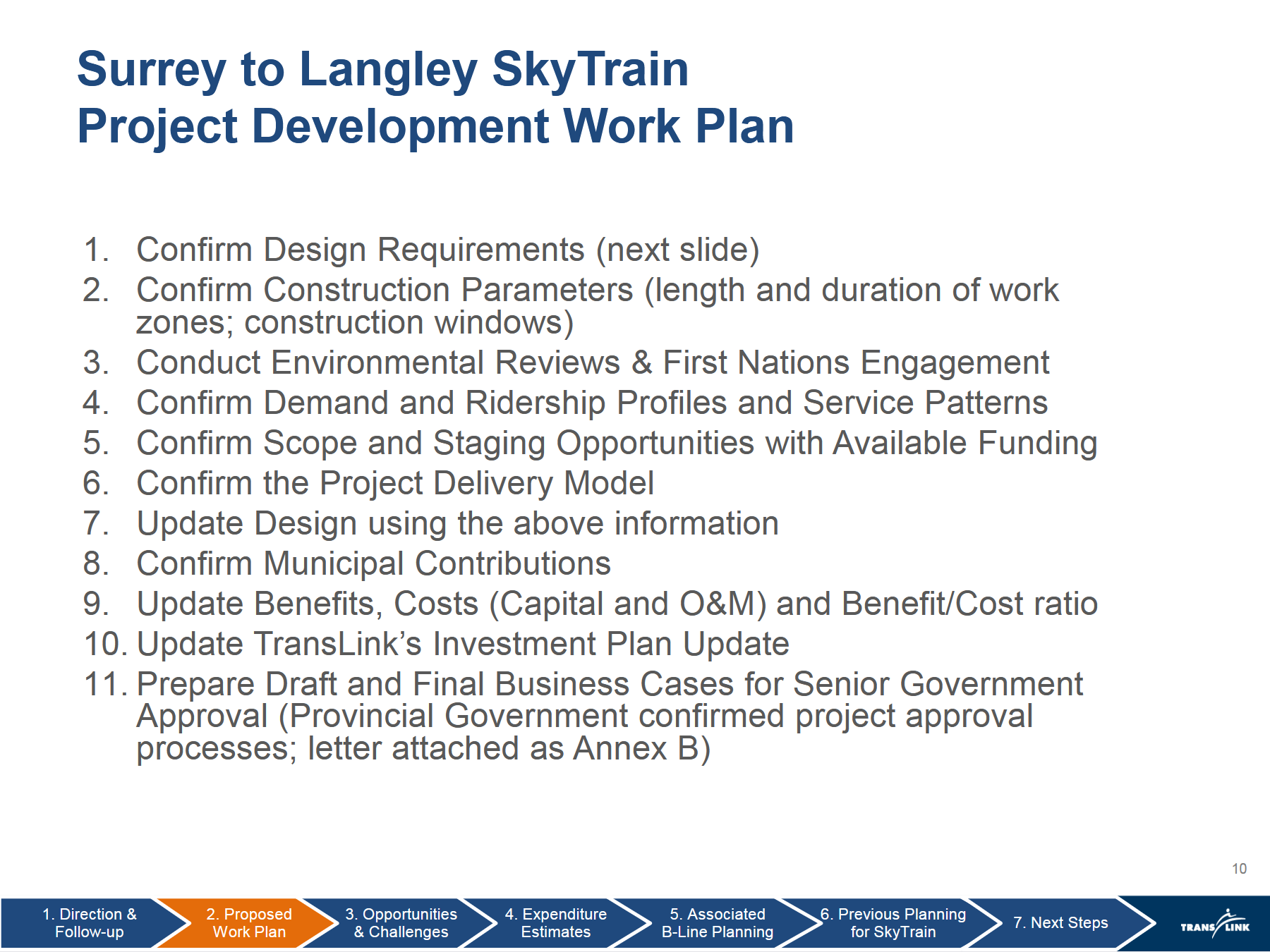
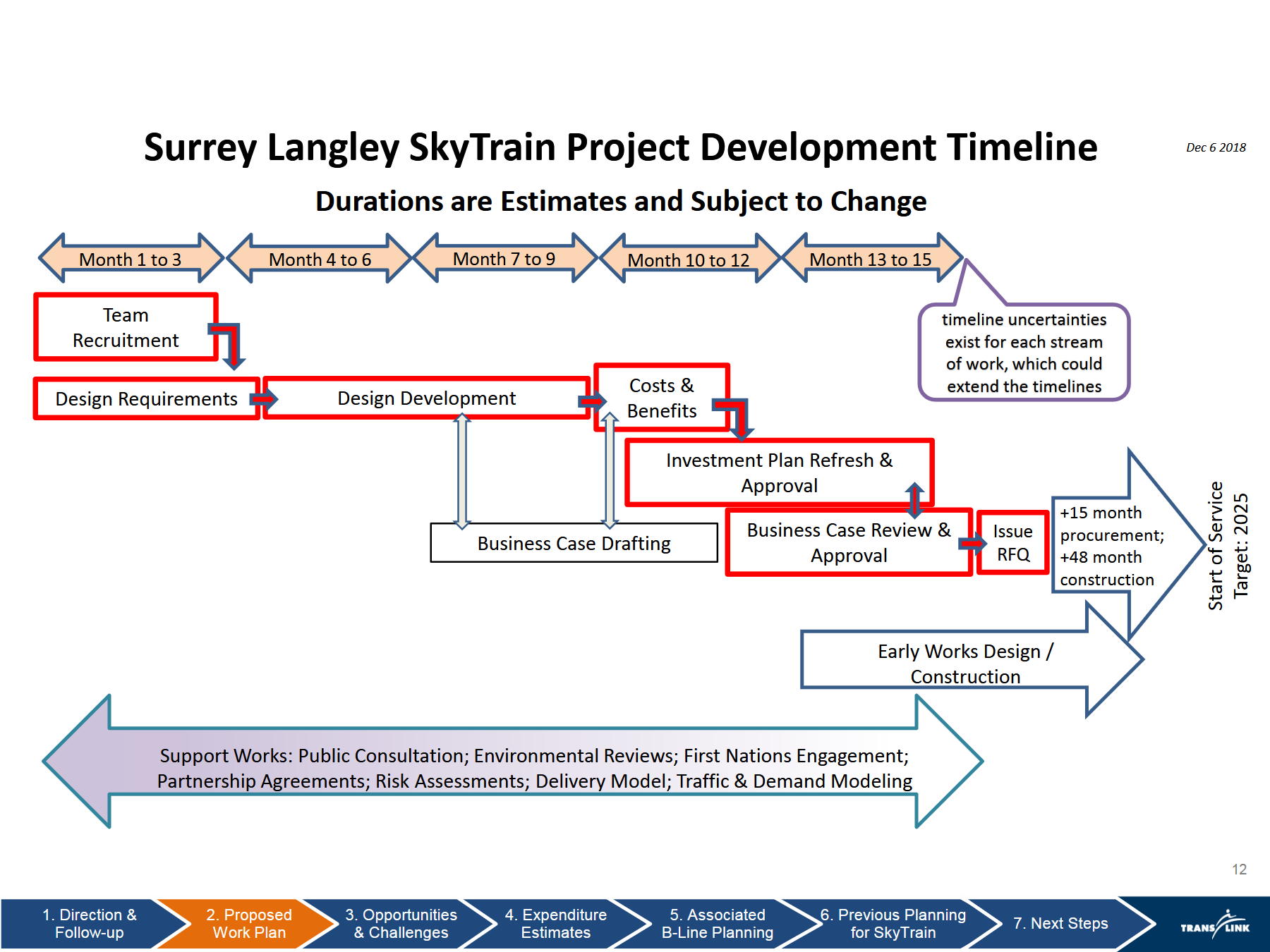
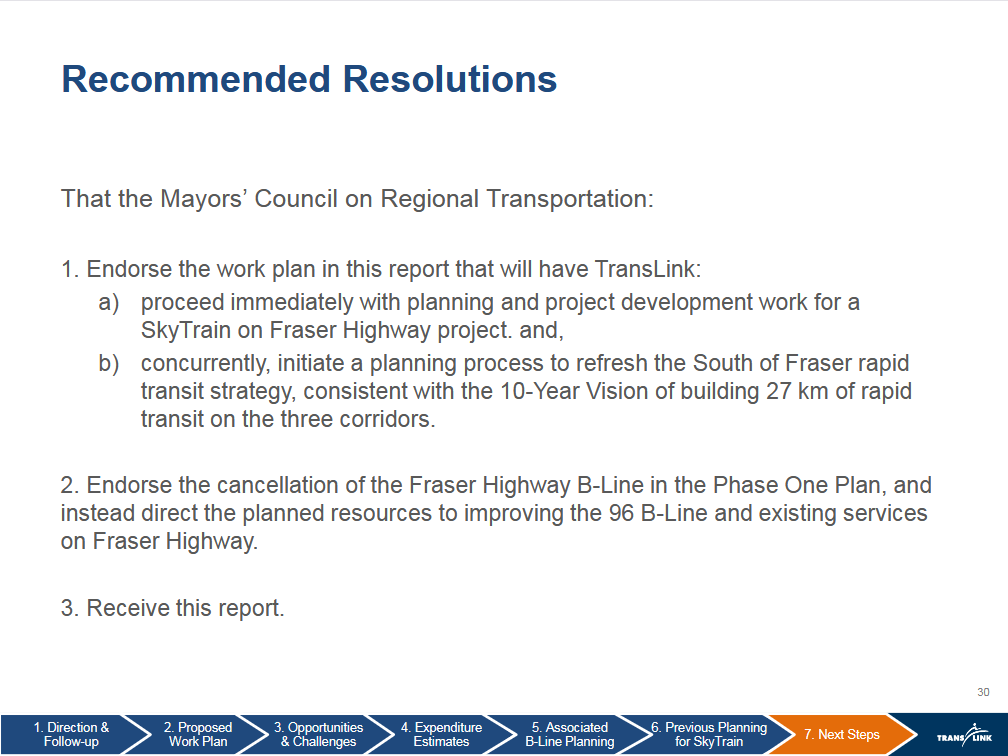
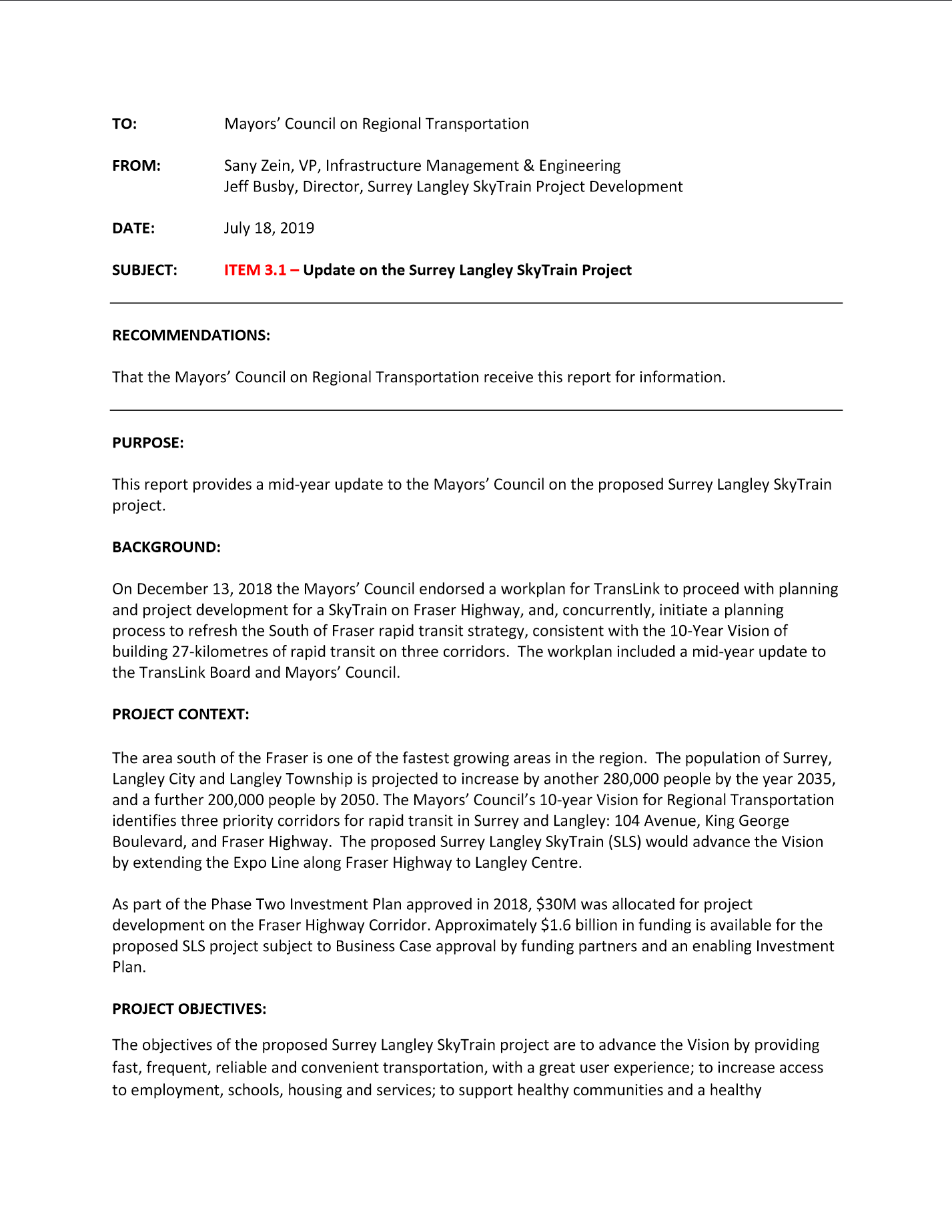
In December 2018—immediately after Surrey cancelled the Surrey-Newton-Guildford LRT—TransLink staff presented a clear work plan to the Mayors’ Council: 15 months for project development and a business case + 15 months for procurement + 4 years for construction.[1]

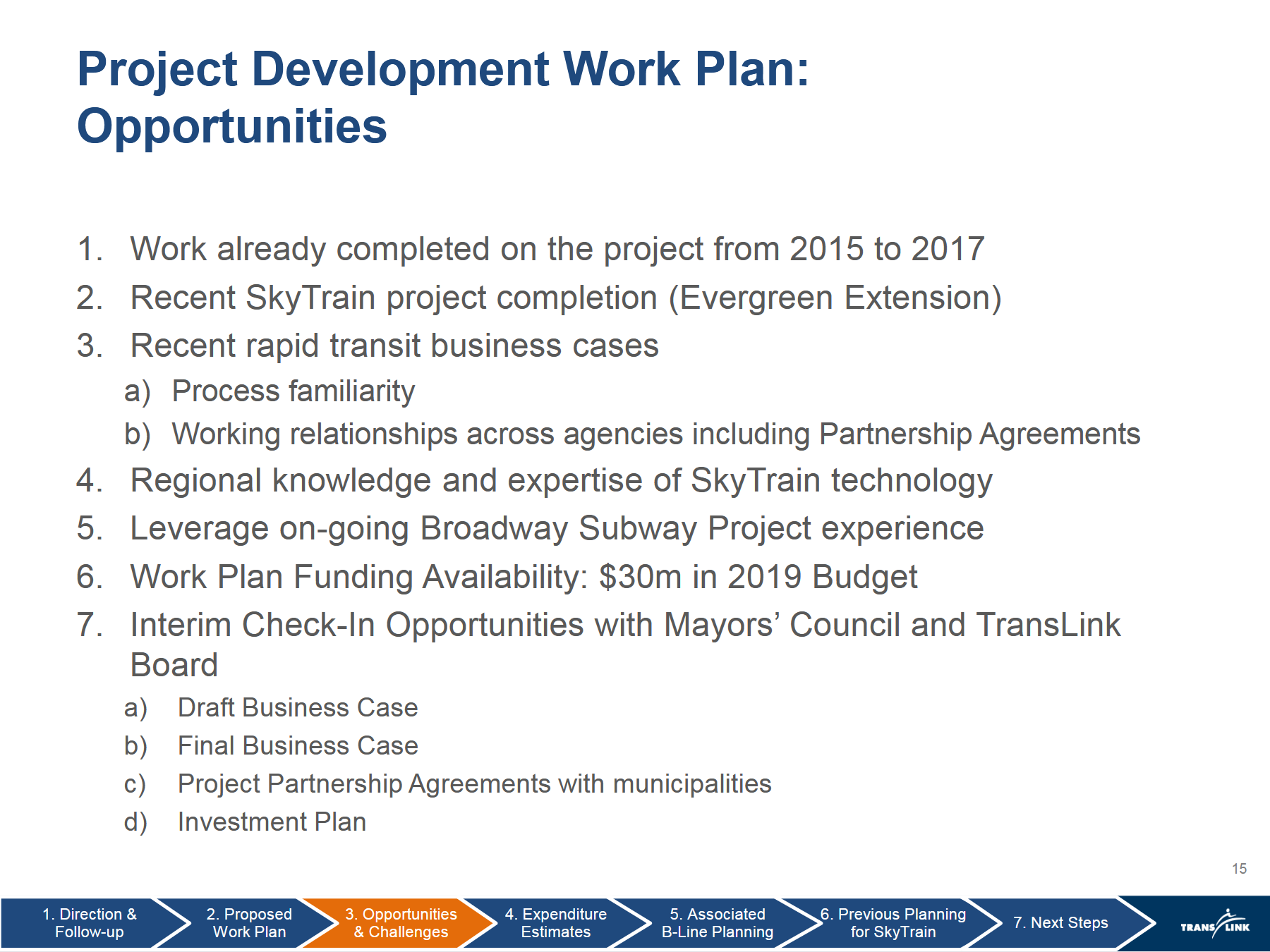
TransLink noted that planners could accelerate work by drawing on past internal corridor assessment work (“from 2015 to 2017”) and lessons learned from the recently completed Evergreen SkyTrain Extension. That exact same head start exists today for the Newton corridor.

Under TransLink’s leadership, the SLS project stayed right on schedule:

    • July 2019: A progress update confirmed the timeline was holding steady and urged building all 16 kilometres in a single phase, noting the construction window would be identical to building just the first 6 kilometres[2]. Construction, testing, and commissioning were slated for 15 quarters—from Q2 2022 to opening day in Q4 2025.
    • January 2020: Right on cue, TransLink delivered a preliminary business case. It confirmed a positive benefit-cost ratio of 1.24 and reaffirmed a late-2025 opening, contingent on final project approval that summer.[3]

How the pandemic shifted the timeline

In March 2020—just weeks before an expected funding announcement—COVID-19 hit. By May, TransLink had shelved its region-wide “Phase 2” transit plan, leaving the SLS in limbo.

Ultimately, a fall 2020 provincial election commitment to build all 16 kilometres at once, followed by federal funding in July 2021, got the project moving again. However, a 2022 updated business case extended the construction and commissioning timeline from 15 quarters to 20 (Q4 2023 to Q3 2028) to account for post-pandemic labour and material constraints.[4]

Despite those extraordinary disruptions, the pre-2020 record suggests that under normal conditions, TransLink can take a Surrey SkyTrain extension from concept to opening day in roughly five to seven years.

2. Millennium Line - just 4 years to develop and build the first 19km

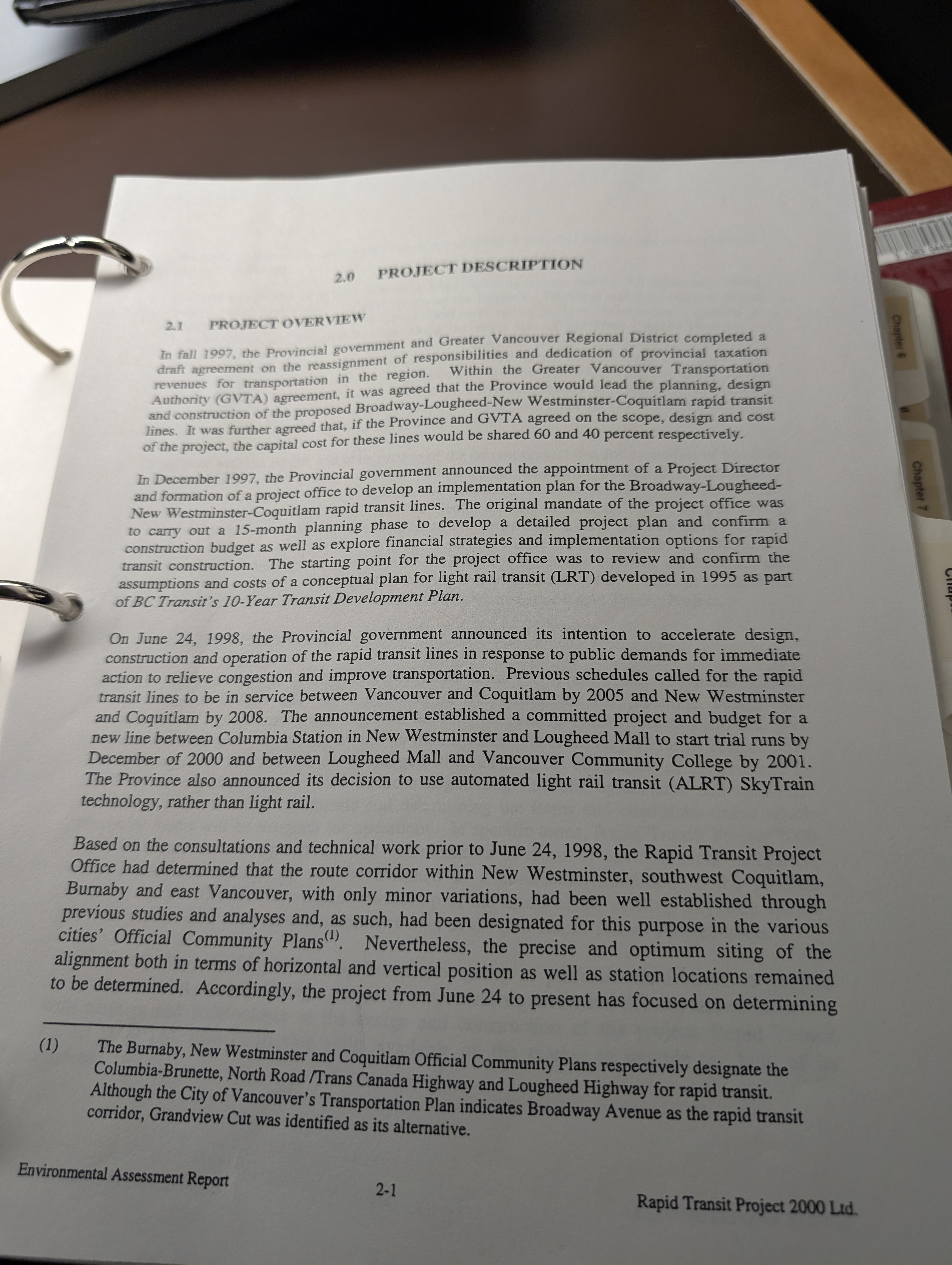
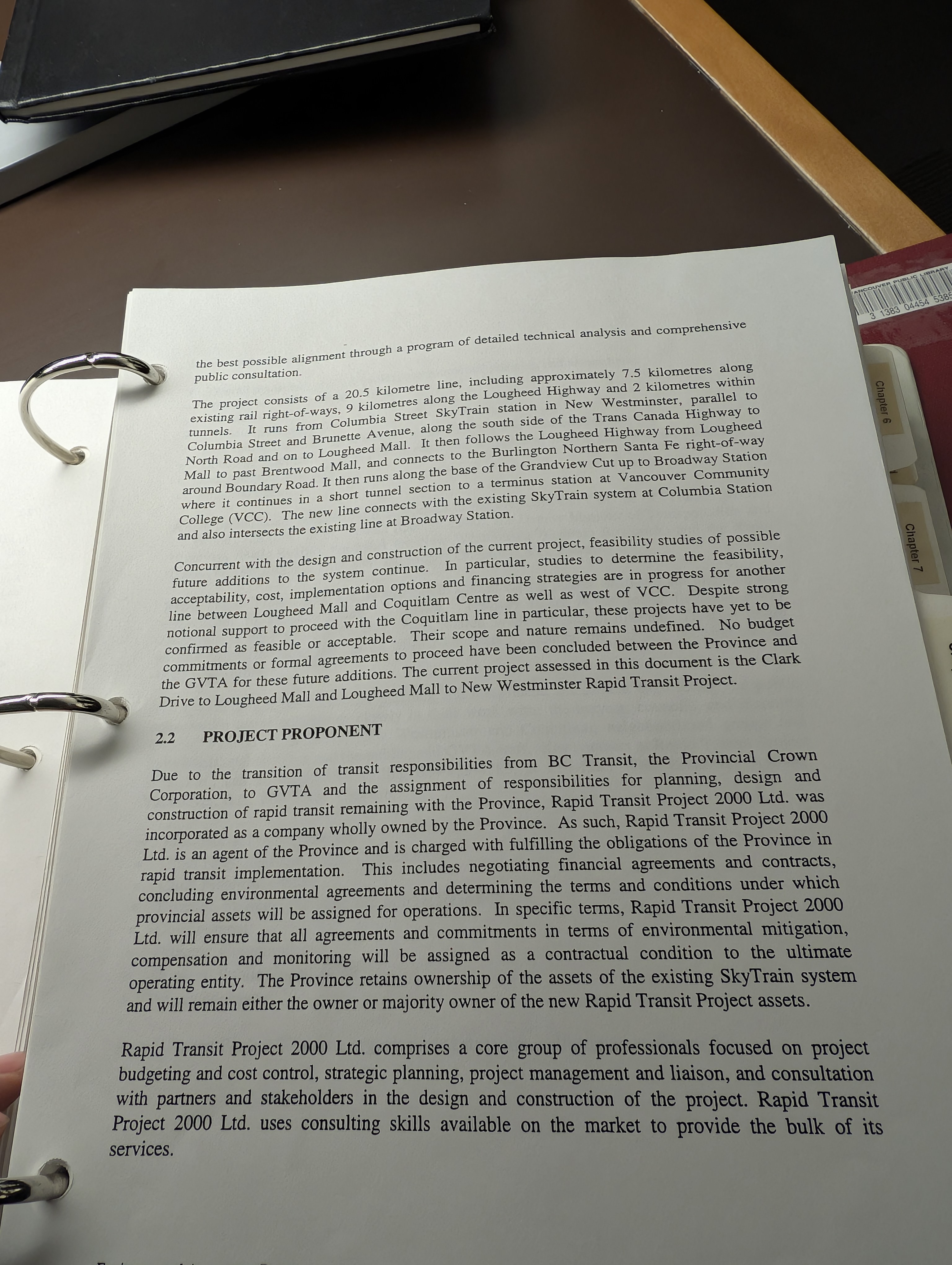
The project that ultimately became the Millennium Line emerged from planning work that began in early 1998. Then known as the “Broadway-Lougheed Rapid Transit corridor”, decision-makers at the time were examining at-grade light rail transit (LRT) options that differed substantially from the final Millennium Line SkyTrain project.

However, in June 1998, the province pivoted to SkyTrain technology as part of a deal bringing a new Bombardier manufacturing plant to B.C.[5] Because of the switch in technologies from LRT to SkyTrain (necessitating changes such as planning for full grade separation), work on the project essentially had to start from scratch.

Archival records we reviewed at the Vancouver Central Library show an astonishing pace of development:

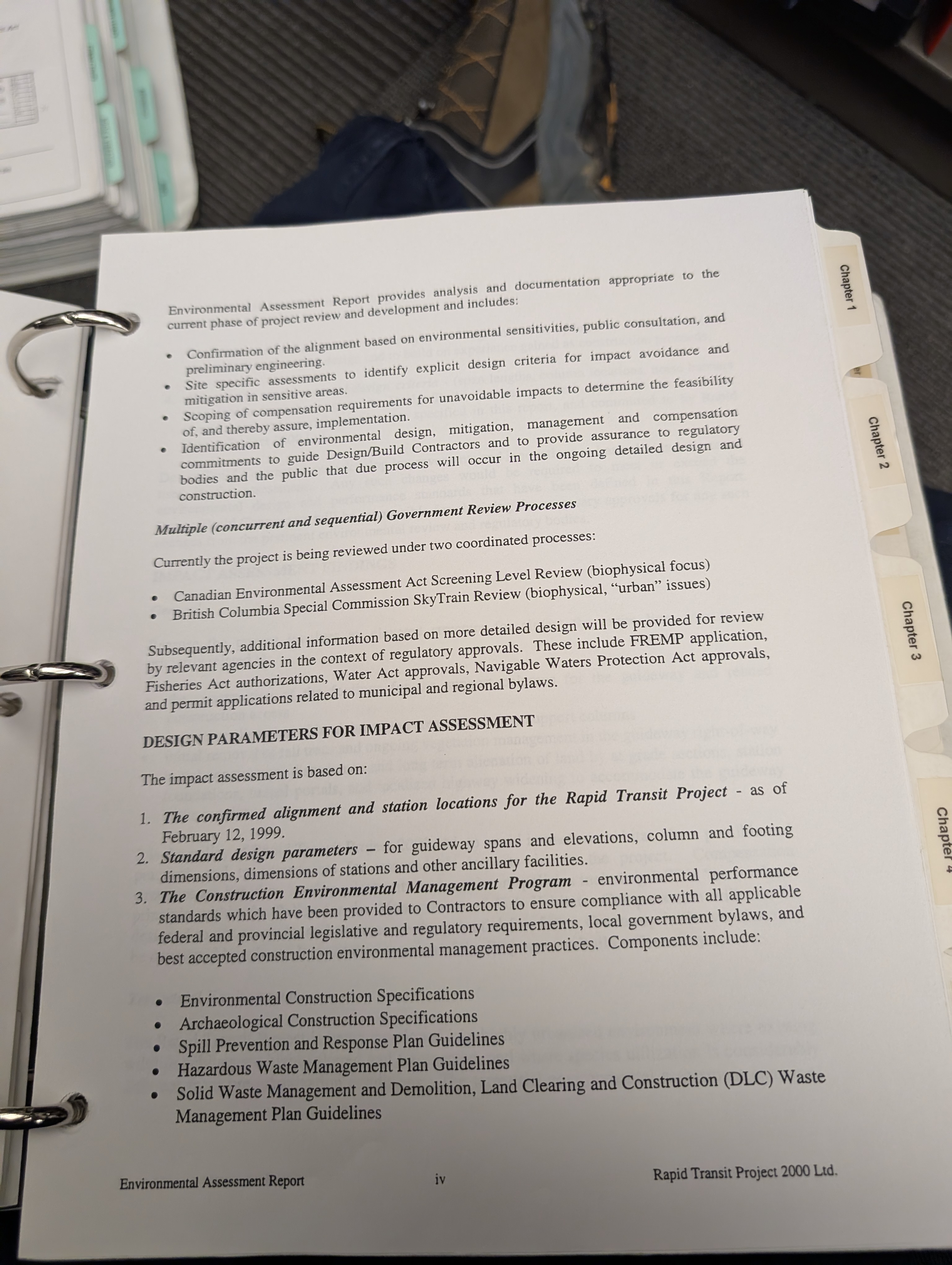
    • February 1999: Project alignment largely finalized.
    • March 1999: Environmental assessment report completed.
    • May 1999: Additional Special Commission SkyTrain review wrapped up.[6]

Meaning that, in less than 12 months, the Millennium Line went from zero dedicated SkyTrain engineering to virtually shovel-ready.

Construction began in New Westminster in October 1999[7]. Less than three years later, the initial 3.5-kilometre segment from Columbia to Braid opened in January 2002, followed by the full 19-kilometre line to Commercial Drive in August 2002.

While the political, economic, and regulatory environment of the late 1990s differed from today, the Millennium Line remains an important reminder that major transit projects do not necessarily require a decade or more between announcement and opening. When governments treat rapid transit as a priority, planning, approvals, procurement, and construction can overlap and proceed on accelerated schedules.
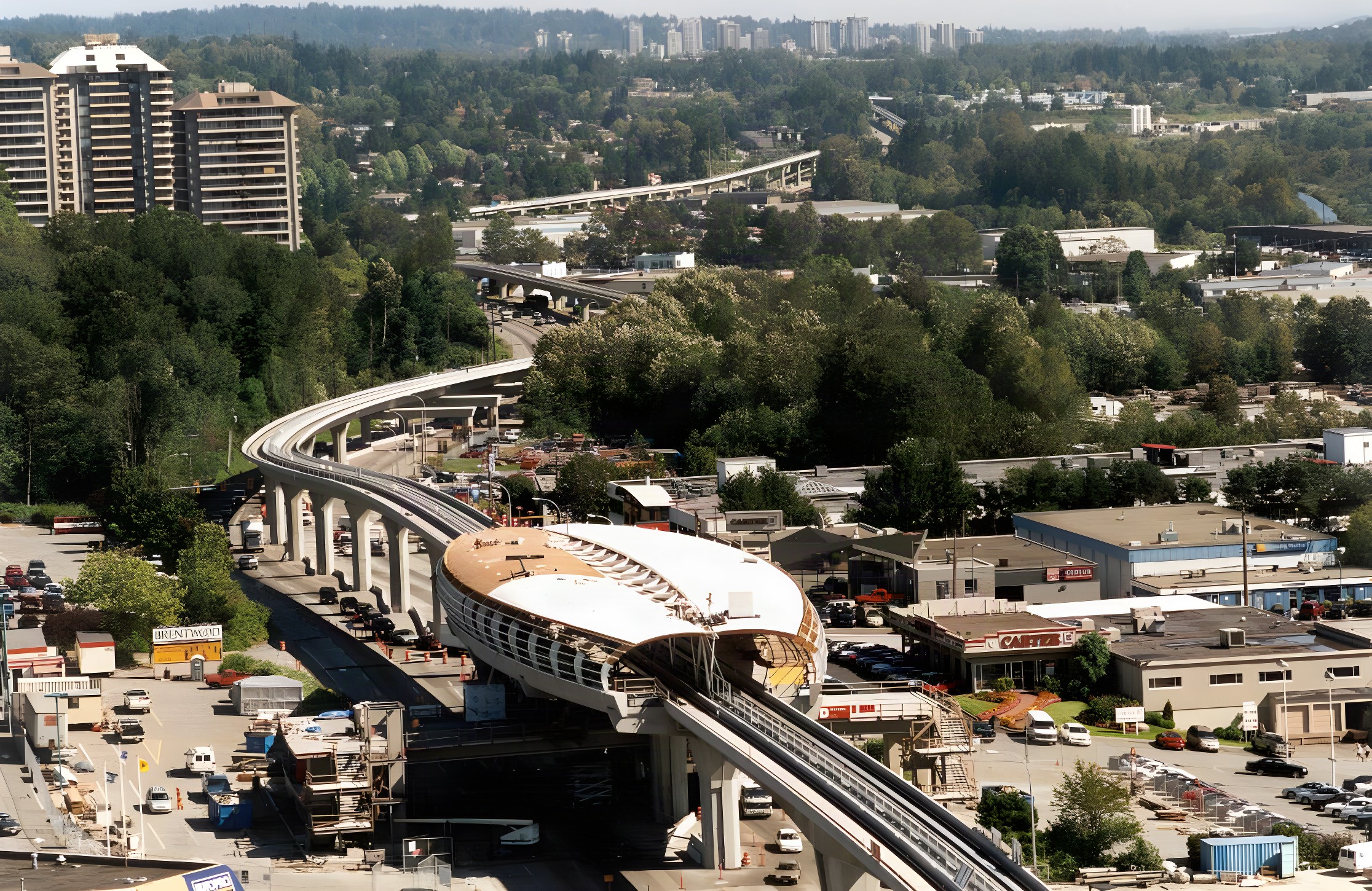
Construction of the Millennium Line SkyTrain near Brentwood Town Centre Station

3. Canada Line - 6 years through political gridlock and tunnelling

Perhaps the most impressive precedent is the Canada Line—Metro Vancouver’s first majority-tunnelled rapid transit line, built with its own dedicated operations and maintenance centre. It introduced a new train technology, required the construction of extensive bored and cut-and-cover tunnels, crossed multiple municipalities, and was tied to the immovable deadline of the 2010 Winter Olympics.

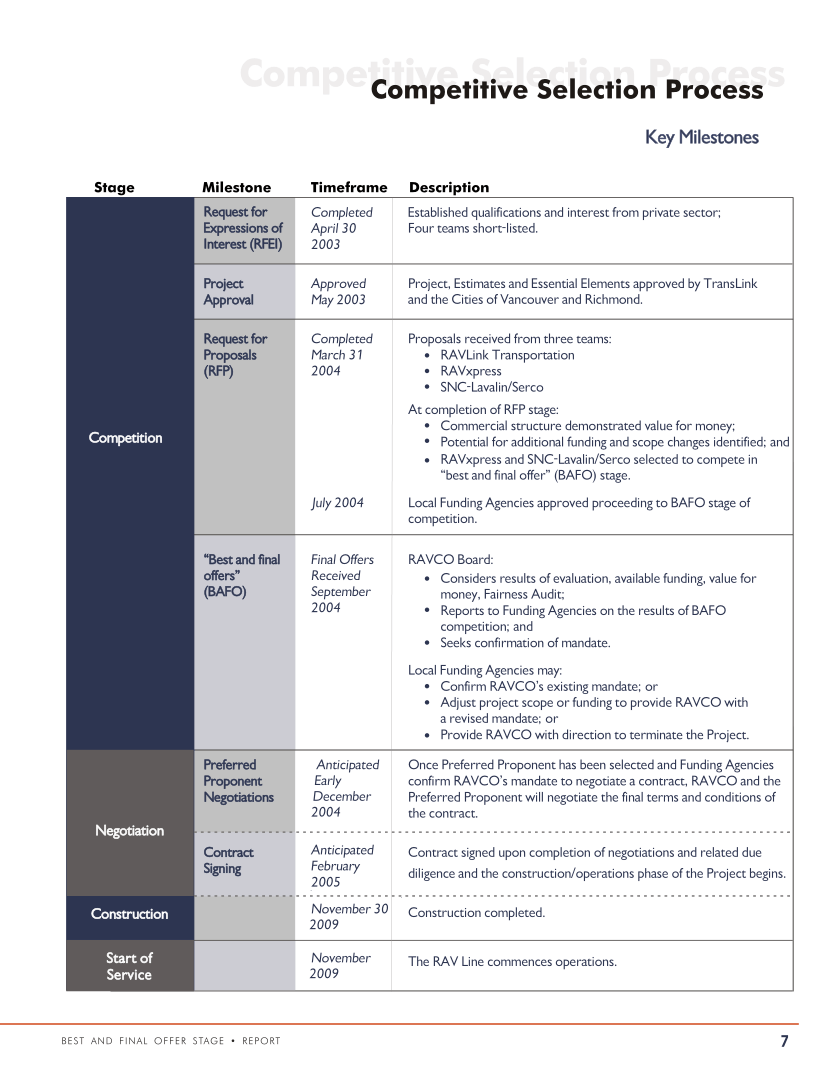
Despite massive engineering complexity and fierce political hurdles, it went from initial procurement in April 2003 to opening day in August 2009—a period of just over 6 years.[8]

Canada Line - Competitive Selection Process Key Milestones

Originally announced alongside the Millennium Line in June 1998 as the Richmond-Airport-Vancouver (“RAV”) line, the project was tied to Vancouver’s bid at the time for the 2010 Winter Olympics, with a bus rapid transit line (the 98 B-Line) serving as an interim measure.[9]

Overcoming near-fatal delays

Before breaking ground, the project survived a gauntlet of setbacks that threatened to derail it completely:

        • 2001: From April to August, bus drivers with the Coast Mountain Bus Company were on a 4-month strike, delaying both the launch of the 98 B-Line and overall project development on the RAV line SkyTrain. Meanwhile, Ottawa pushed the region toward a Public-Private Partnership (P3) funding model that had not been tested for transit projects.[10]
        • February 2002: TransLink approves RAV SkyTrain, but ranks it dead last in a list of 5 priority projects to submit for federal funding. (At the time, SkyTrain projects to Coquitlam (the Evergreen Extension) and West Broadway (the Broadway Subway) were ranked higher.)[11]
        • 2023: In May, the Greater Vancouver Regional District (the predecessor to today’s Metro Vancouver) voted to approve its funding share for the RAV line so that it may be constructed by 2009, to support Vancouver’s bid for the 2010 Winter Olympics[12]. When the Olympics bid was then won in July, then-Premier Gordon Campbell noted that there was a 3-5 week deadline to finalize federal project funding, or else the RAV line “may miss the Olympics”.[13]
        • May–June 2004: TransLink’s Board of Directors—then composed entirely of Metro Vancouver mayors and councillors, similar to today’s Regional Mayors Council—vote against building the RAV line twice over “high” capital costs—on May 7, then again on June 18.[14][15]
        • Late June 2004: On a third vote, the Board reversed course and approved RAV, but imposed a strict $1.35 billion public funding cap.[16]
        • November 2004: The winning P3 bid from the SNC-Lavalin consortium came in over the $1.35 billion limit.[8]

In the end, the RAV line project was rescued at the eleventh hour through additional contributions from the province ($65M), TransLink ($101M), and the SNC-Lavalin consortium ($206M). Much of the political heavy lifting to secure that deal was led by TransLink’s Board Chair at the time—former (and current) Surrey Mayor Doug McCallum, who had supported RAV line at all of its May-June 2004 votes.[17][18]

Built in 4.5 years—and opened early

With financing and development finalized in early 2005, contractors raced against a hard deadline: the 2010 Winter Olympics, which had been awarded to Vancouver in 2003 . The earlier setbacks meant that the project now had to proceed on a significantly accelerated timeline.

Just four-and-a-half years later, the 19-kilometre mix of tunnels, elevated guideways, and surface track opened to the public on August 17, 2009—three-and-a-half months ahead of schedule.
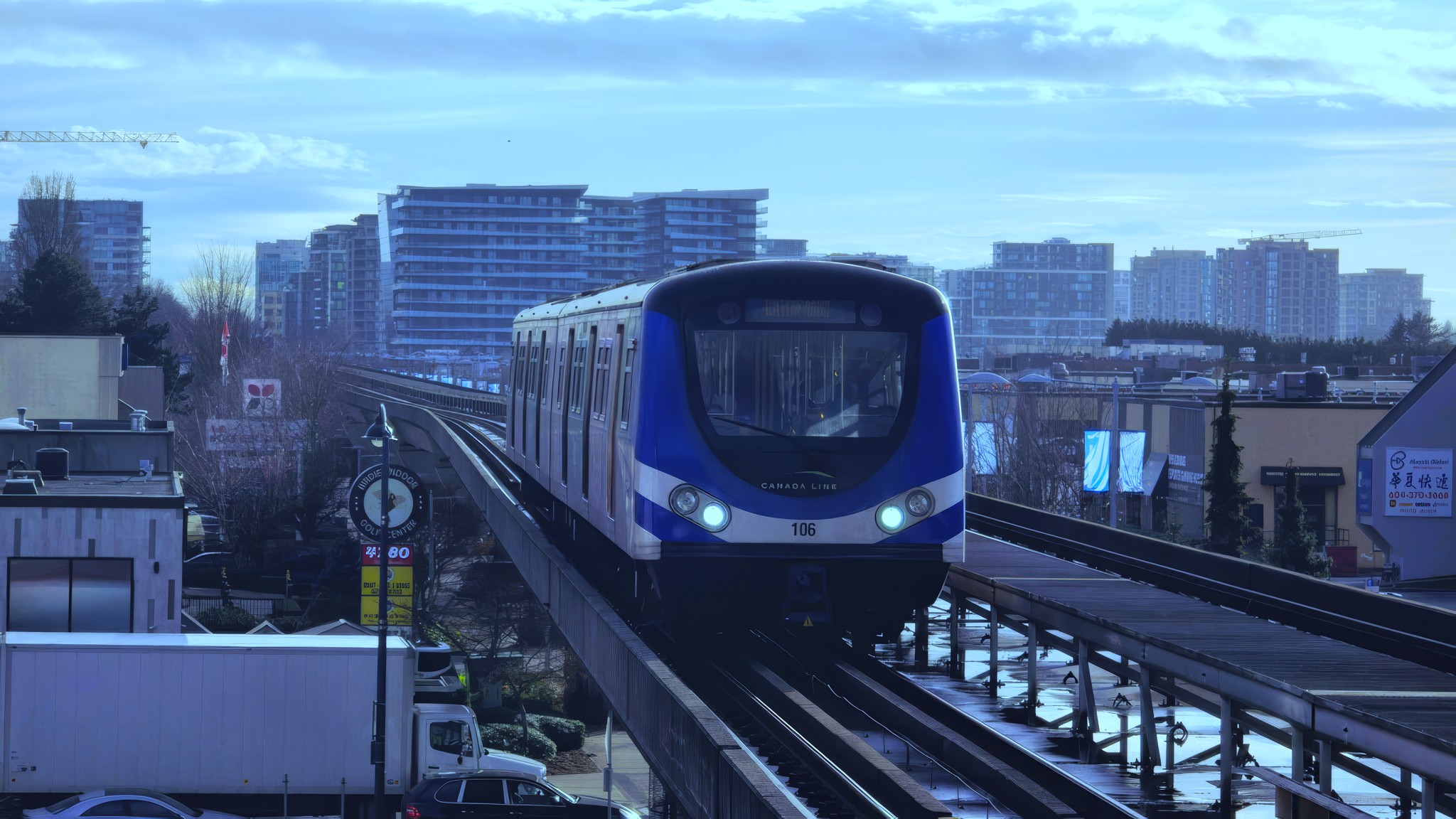
A Canada Line train approaching

Looking forward to a SkyTrain to Newton

Critics who claim a SkyTrain to Newton will take 10 or 15 years are treating worst-case or political delays as an engineering rule.

Taken together, the Millennium Line, Canada Line, and pre-pandemic Surrey Langley SkyTrain timelines point to a consistent takeaway: a five-to-seven-year delivery window is entirely achievable under focused governance.

Furthermore, with existing corridor studies in hand and no major tunnelling required, expanding SkyTrain to Newton is one of the most straightforward rapid transit projects in the region. We recently predicted in a detailed analysis that a 2032-2035 opening year timeline for a Newton SkyTrain extension is achievable.[19]

ProjectDevelopment StartOpeningTime
Millennium Line19982002~4 years
Canada Line20032009~6 years
Surrey Langley SkyTrain (original plan)20182025~7 years
SkyTrain to Newton (our prediction)20272032-2035~5-8 years

For the tens of thousands of students, workers, and families who rely on overcrowded buses along King George Boulevard every day, rapid transit isn’t an abstract policy debate—it’s hours of their week on the line. However, history shows that we know how to build SkyTrain quickly when the commitment is real.

As such, the timeline for the Newton SkyTrain extension will ultimately come down to whether our provincial and regional leaders choose to treat Surrey’s transit needs with the same urgency that they brought to SkyTrain lines in the past.

Footnotes

  1. Dec 2018 – TransLink Management Report to Mayors’ Council on South of Fraser Rapid Transit (PDF) — Surrey Langley SkyTrain project website[↩]
  2. July 2019 – TransLink Management Report to Mayors’ Council on Surrey Langley SkyTrain Project and South of Fraser Rapid Transit Strategy Refresh (PDF) — Surrey Langley SkyTrain project website[↩]
  3. Jan 2020 – TransLink Surrey Langley SkyTrain Business Case Summary (PDF) — Surrey Langley SkyTrain project website[↩]
  4. SLS Project Business Case (July 18, 2022) — Surrey Langley SkyTrain project website[↩]
  5. “Transit contractor Bombardier must build B.C. Plant, Clark says” — Vancouver Sun, June 3 1998 issue, front page. Viewable on ProQuest archives[↩]
  6. Millennium Line special commission SkyTrain review — BC gov, May 1999[↩]
  7. “1999 October — Millennium Line construction starts in New Westminster”. From “The Road Less Travelled — TransLink’s Improbable Journey from 1999 to 2008” — TransLink, 2008[↩]
  8. Canada Line Best and Final Offer Final Project Report — RAVCO, Nov 2004[↩][↩]
  9. SkyTrain line to Airport proposed — Vancouver Sun, June 25 1998 issue, section B, page B1. Viewable on ProQuest archives[↩]
  10. In December 2001, the federal government announced a new $2 billion funding stream (the Canada Strategic Infrastructure Fund) encouraging the adoption of a public-private partnership (“P3”) model, which planners sought to use for the RAV line. See: Canada Strategic Infrastructure Fund Projects[↩]
  11. From 2006 paper: Mega-Projects in the Making, p.267-268, figure 9.2[↩]
  12. “A ‘Cadillac’ RAV gets green light” — The Province, May 29 2003 issue, page A3. Viewable on ProQuest archives[↩]
  13. “RAV line may miss the Olympics, premier says” — Vancouver Sun, July 8 2003 issue, front page. Viewable on ProQuest archives[↩]
  14. “RAV line sent back to drawing board” — Vancouver Sun, May 8 2003 issue, front page. Viewable on ProQuest archives[↩]
  15. See: City of Richmond Council minutes — 2004[↩]
  16. RAV wins TransLink approval — CBC, June 30, 2004[↩]
  17. “TransLink chair confident RAV will be saved” — Vancouver Sun, November 23 2004 issue, section B, page B5. Viewable on ProQuest archives[↩]
  18. “RAV to be built in time for 2010 Games” — Vancouver Sun, December 2 2004 issue, page A4. Viewable on ProQuest archives[↩]
  19. Comparing SkyTrain to Newton to TransLink’s original King George Boulevard BRT — SkyTrain for Surrey[↩]

Pictured in header: Surrey Langley SkyTrain construction and gantry at Fleetwood Station (156 Street)

Reality Check

Reality Check is the online blog run by the founder of SkyTrain for Surrey, a BC-based community organization that has advocated for expanding the Vancouver SkyTrain system, including our successful advocacy for the under-construction Surrey-Langley SkyTrain extension and the proposed SkyTrain expansion to Newton.

Media Contact: Daryl Dela Cruz ​– Founder, SkyTrain for Surrey ・ Phone: +1 604 329 3529, [email protected]

How Fast Can SkyTrain to Newton Be Built? Lessons from Three Past SkyTrain Projects