 Daryl DC (SfS Founder)
The last few weeks have been an incredibly exciting time for stakeholders of Surrey’s ongoing transit system expansion, already anchored by the 16-kilometre Surrey Langley SkyTrain on Fraser Highway. With two elections (municipal and provincial) having come and gone, it is now clear that there will be some exciting changes for the transit future of Surrey’s King George Boulevard corridor.
Here at SkyTrain for Surrey, we think the rationale for advancing SkyTrain expansion is clear, and we will of course be supporting the current direction fully. However, I am sure there is as much anxiety as there is excitement about the recent announcements, given that there will once again be a switchover of project technology (this time from Bus Rapid Transit to SkyTrain) and different timelines for each portion of the corridor.
As such, we have put together a detailed comparison and overview below of what transit on the King George Boulevard corridor will look like with SkyTrain on the corridor instead of the BRT, including addressing some misinformation on the subject.
The portion of the King George Boulevard BRT between City Centre and Newton would be replaced by an elevated SkyTrain line. Hooray!
A SkyTrain extension instead of the BRT project means that transit riders will experience more reliable commutes and faster travel times, with elevated trains unimpeded by traffic. This will attract thousands of new public transit riders and take huge volumes of cars off the road.
Our organization has called on decision-makers to begin construction on the Newton SkyTrain expansion within the next 4 years, proceeding ahead of the UBC SkyTrain extension if work on that extension has not been started already by that time.
If ongoing construction activities for the Surrey Langley SkyTrain expansion are leveraged to jump-start expansion for the Newton SkyTrain corridor (which both the incoming provincial Conservative premier and rival/outgoing BC NDP premier have suggested is possible), we estimate that the extension to Newton could be done within a condensed construction timeline of just 3 years instead of the typical 4-5 years.[3]
Whether the condensed construction timeline is possible or not, we think it is reasonable to expect that—barring any further reasons for a delay, such as funding and budgeting—a Newton SkyTrain extension could be up and running between the years 2032 and 2035.

More information:

More information:
The remainder of the King George Boulevard corridor spanning from Newton Town Centre to South Surrey was expected to be part of the King George Boulevard Bus Rapid Transit (BRT) project led by TransLink. The segment of this project between City Centre and Newton is now expected to be replaced by the Newton SkyTrain extension.
A decision on what will happen to the remaining segment of the BRT project (Newton to South Surrey) is expected to be made in the near future by TransLink, and we understand that there have been rumours that this portion of the BRT project will be cancelled.
However, we believe that the delivery of the remaining Newton to South Surrey segment would cost significantly less per-kilometre than the full King George Boulevard BRT, based on the project characteristics that had been previously released by TransLink.
Notably, a large segment of the Newton to South Surrey corridor (“segment S3” between Highway 10 and Crescent Road) was expected to run in mixed traffic with no changes to the roadway, as King George Boulevard here functions as a divided rural expressway—with a concrete median, a 70 km/h speed limit, grade-separated interchanges (such as at Colebrook Road), and no traffic lights.
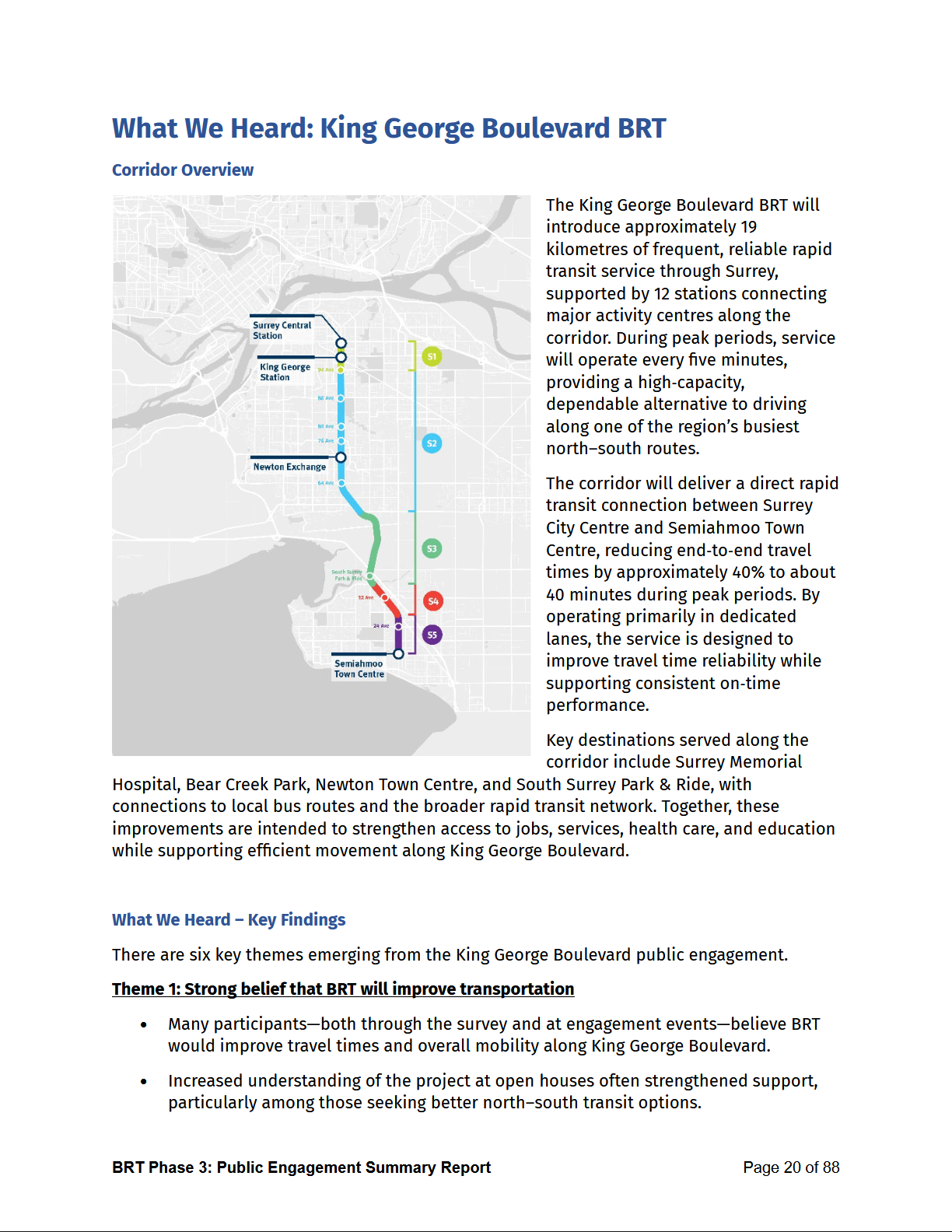
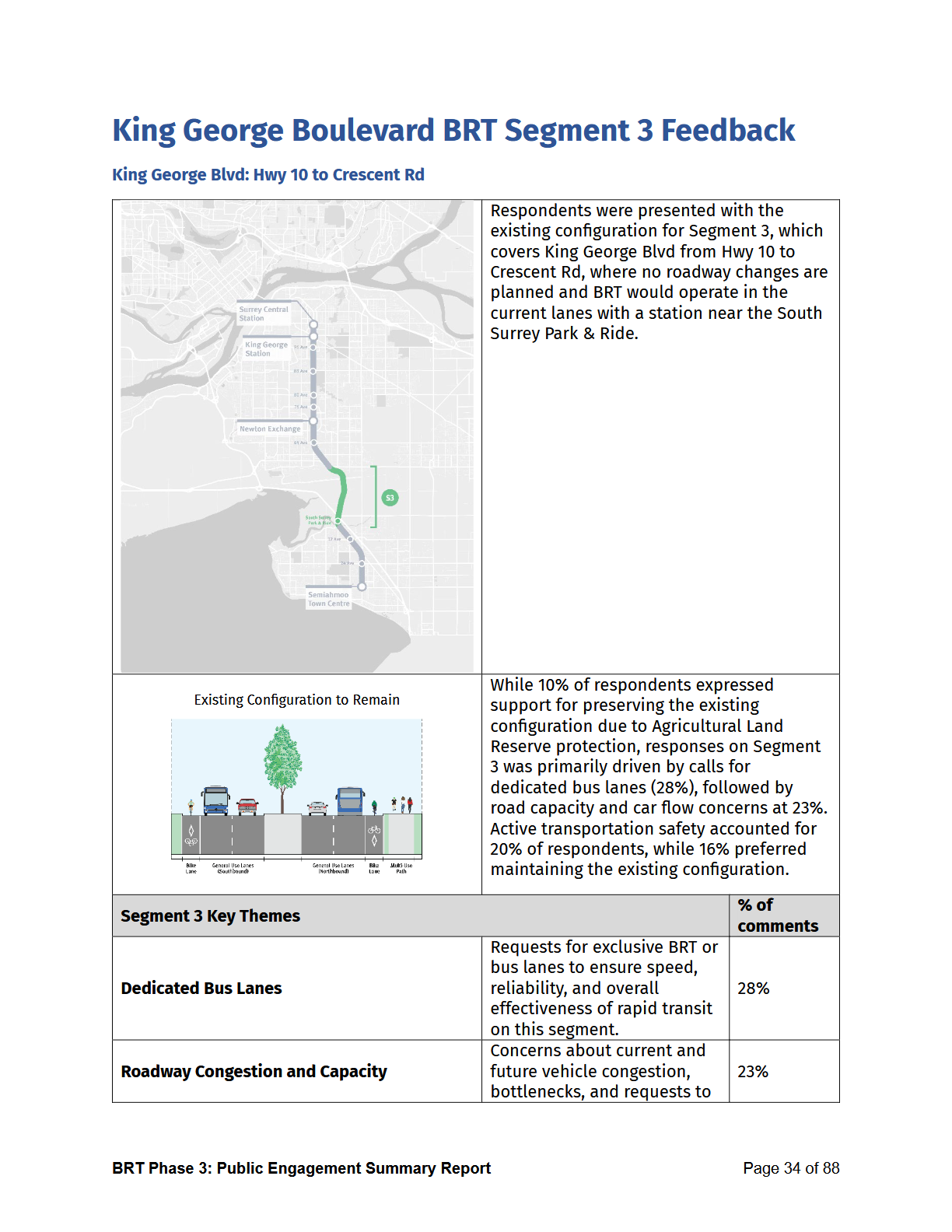
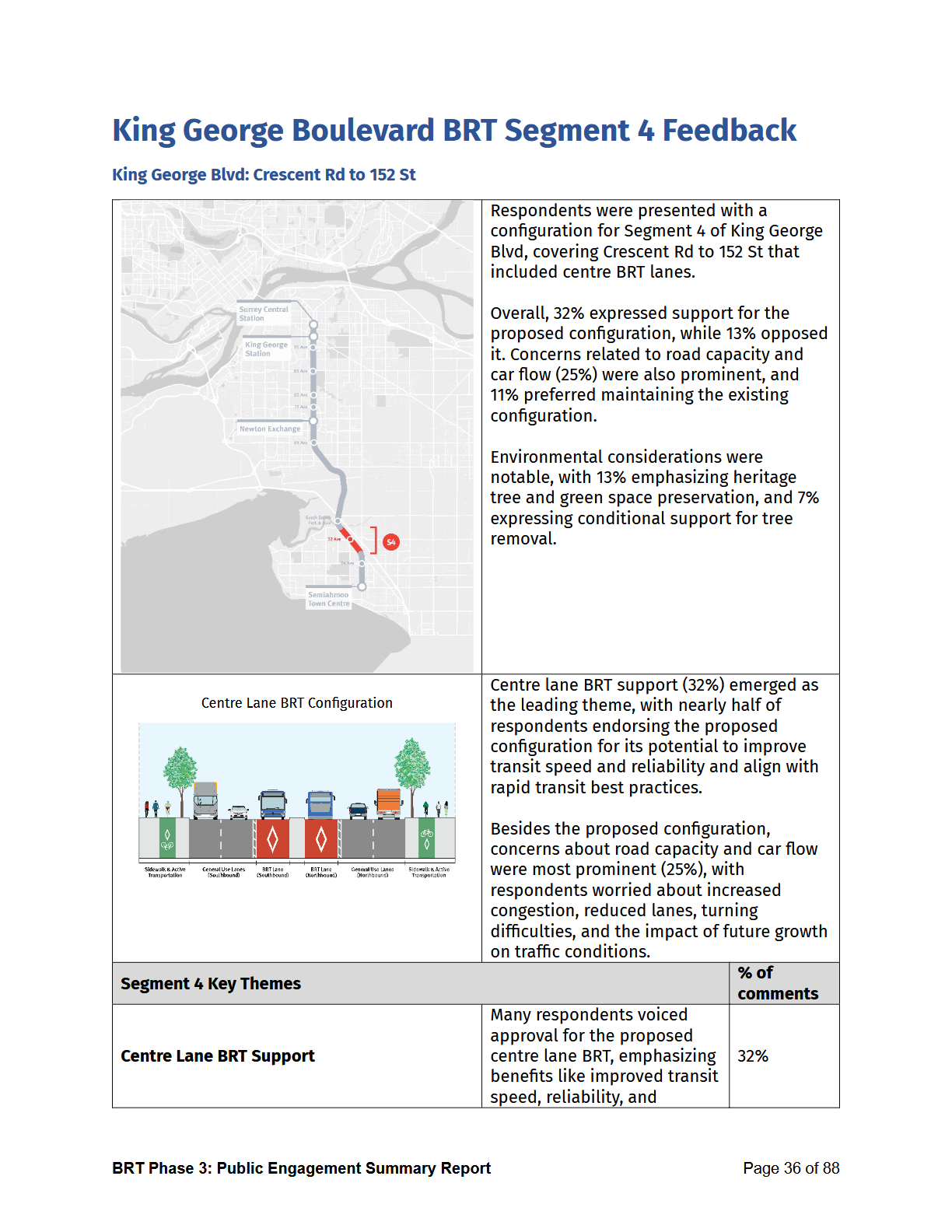
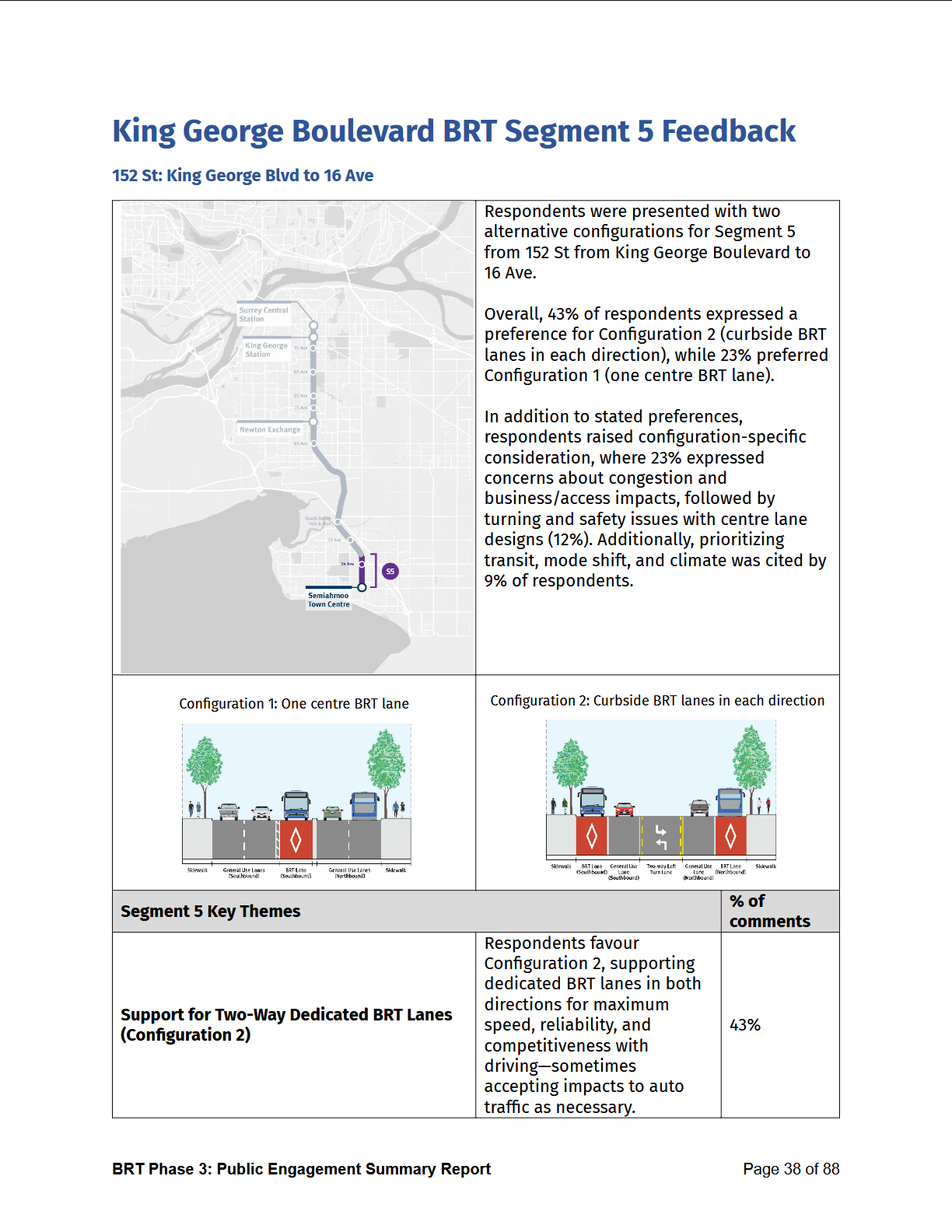
The remainder of the project would entail adding 5.5 kilometres of dual-direction median busway with road widening[4], 2.25 kilometres of single- or dual-direction busway without road widening on 152 Street[5], and 10 BRT platforms[6].
This means that a retooled BRT between Newton and South Surrey only would have less than half of the infrastructure requirements of the original BRT project; 6.5 kilometres of dual-direction median busway and 12 BRT platforms[7] would be eliminated in favour of the SkyTrain.[8]
| Full King George Blvd. BRT (original plan) | Shortened King George Blvd. BRT (Newton to South Surrey) | |
| Total length of service corridor | 19 kilometres | 12.5 kilometres |
| BRT dedicated lane-kilometres[9] | 26.55 to 28.8 kilometres[5] | 13.35 to 15.6 kilometres[5] |
| Length of roadway requiring road widening and reconfiguration to add median busway | 12.1 kilometres[10] | 5.55 kilometres[4] |
| # of BRT platforms | 22 BRT platforms | 10 BRT platforms |
| Approx. infrastructure requirement relative to full 19km BRT proposal | 100% | 45% |
| Est. cost extrapolated from revised infrastructure requirements alone[11] | $700 million[12] | $315 million |
| Cost per kilometre | $36.8 million per km | $25.2 million per km |
ALSO, as the eliminated segment runs on the much busier portion of King George Boulevard between City Centre and Newton, we assume that the construction costs would have been proportionally higher in this segment, due to the need for more traffic mitigation measures.[13]
We therefore estimate that the shortened Newton to South Surrey BRT project could be reduced even further—potentially carrying only 1/3 the costs of the full King George BRT, with less than half of the infrastructure requirements.
It’s important to remember that the King George Boulevard BRT did not and still does not have a TransLink-published expected opening date, although many—including former City Councillors[14]—believed that the BRT would be up and running in 2030.
It’s also important to remember that the King George BRT did not have any funding committed—at least not at the time that City Council passed its unanimous vote in favour of a Newton SkyTrain extension (it’s noteworthy that for a brief period of time, the King George BRT did have a $250 million funding commitment secured from the BC NDP provincial government—until the BC NDP subsequently withdrew that funding commitment for BRT in favour of supporting a SkyTrain extension to Newton instead).
This funding commitment would have effectively determined the start of construction. However, if we still assume that the full King George Boulevard BRT were to have opened in 2030, our 2032-2035 timeline estimate for SkyTrain represents an approximately 2-5-year delay.
| Segment | King George Boulevard BRT opening date (original plan) | SkyTrain to Newton opening date (our estimate) | SkyTrain, with retained BRT from Newton to S. Surrey |
| City Centre to Newton | 2030 | 2032-2035 | 2032-2035 |
| Newton to South Surrey | 2030 | 2029 |
To potentially offset this, the Newton to South Surrey BRT project could be delivered 1 year faster—in 2029, instead of 2030. This is because the retained BRT segment would be smaller and shorter than the original BRT project, with significantly less infrastructure required and construction also taking place on lower-trafficked portions of King George Boulevard south of Newton Town Centre.[13]
While SkyTrain is under construction in the corridor’s northern half, this BRT infrastructure could be utilized in the interim by an extended R1 RapidBus to Semiahmoo Town Centre—before being upgraded to a full dedicated BRT service in conjunction with the launch of SkyTrain. This phased/interim approach is commonly used when introducting new BRT lines.[15][16]
We have prepared 6 different sample scenarios for a weekday afternoon (PM rush hour, 4-5 P.M.) southbound trip from Downtown Surrey to Newton and Semiahmoo Town Centres, utilizing existing TransLink transit schedules and all available published travel time estimates.
| from Downtown Surrey… | to Newton Town Centre | to Semiahmoo Town Centre |
| 1 — Existing King George Blvd. buses (R1/#321/#394) | 25-35 minutes | 65-75 minutes |
| 2 — Full King George Blvd. BRT (original plan) | 15 minutes | 40 minutes[17] |
| 3 — SkyTrain to Newton + #321/#394 (no extra express buses) | 10 minutes[18] | 45-50 minutes |
| 4 — SkyTrain to Newton + R1/new #394 (express bus improvements)[19] | 10 minutes[18] | 35-45 minutes |
| 5 — SkyTrain to Newton + BRT to South Surrey | 10 minutes[18] | 35 minutes |
| 6 — Surrey Langley SkyTrain + #345/#375 (152 Street, no extra express buses) | – | 50-55 minutes[20] |
Under scenarios #3 and #6 where commuters to South Surrey must utilize existing bus services under existing schedules, travel time to South Surrey could potentially average about 5-15 minutes longer than the previous BRT plan. However, this is likely to be mitigated to some extent by either extending the R1 or improving the #394 bus[19][21], which we have included as scenario #4.
However, if the BRT project can be retained between Newton and South Surrey (scenario #5), the resulting travel time of 35 minutes would actually be superior to the original BRT plan.
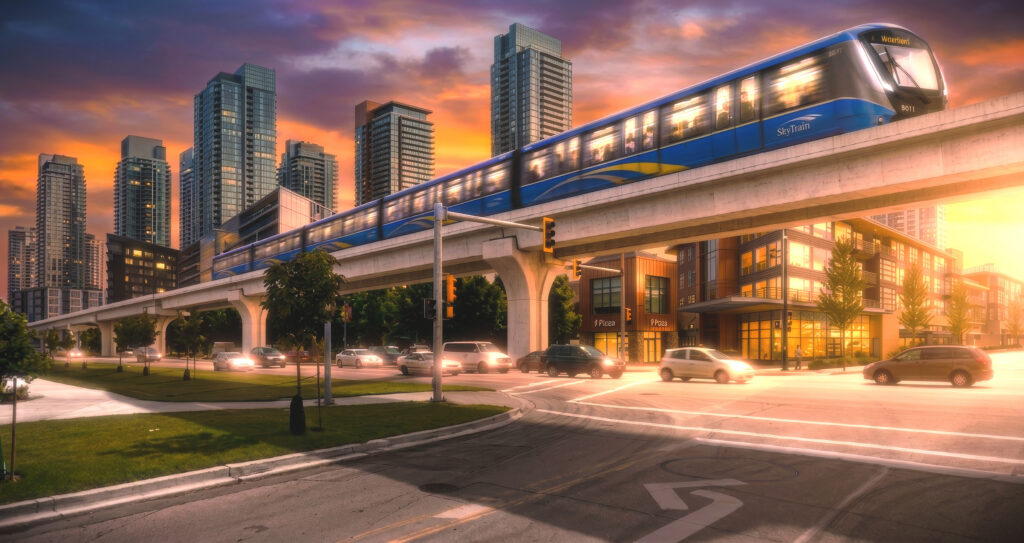
Pictured in header: Render of a King George Boulevard BRT bus, prepared by SkyTrain for Surrey
Reality Check
Reality Check is the online blog run by the founder of SkyTrain for Surrey, a BC-based community organization that has advocated for expanding the Vancouver SkyTrain system, including our successful advocacy for the under-construction Surrey-Langley SkyTrain extension and the proposed SkyTrain expansion to Newton.
Media Contact: Daryl Dela Cruz – Founder, SkyTrain for Surrey ・ Phone: +1 604 329 3529, [email protected]