 Daryl DC (SfS Founder)
I have noticed that at public forums and in local media, many Light Rail Transit (LRT) advocates mix statistics from different systems—streetcars, reserved‑right‑of‑way LRTs, “TramTrain” systems, and commuter rail—and then present those mixed figures as if they all apply to Surrey’s proposed on‑street LRT. This is incredibly problematic, and sets us up to make decisions on transit technology with incorrect information.
A recent example came from Rail for the Valley blog contributor Malcolm Johnston (also known by his online nickname “Zweisystem“), who recently responded to our public commentary with several claims about SkyTrain, LRT, and system costs. However, many of these claims rely on incorrect assumptions, misused terminology, or comparisons that don’t apply to Surrey’s context.
Johnston states in his response that SkyTrain is a “proprietary mini-metro system” and that if Bombardier Inc. (which he describes as “the current owner” of the technology) ceases production, we would “lose our only supplier” for SkyTrain vehicles. Of course, calling SkyTrain a “technology” also reflects a gross misunderstanding of the term, as SkyTrain is a brand name, not a technology.
But more importantly, Bombardier has not indicated in any way that it plans to cease production of SkyTrain-compatible linear motor trains. In fact, the opposite is true, as Bombardier recently revealed in a marketing video that it has designed a new generation of ART cars.
Johnson goes on to say that we should choose light rail because “only seven SkyTrain-type systems have been built” and that “over 100 new light rail systems were built during the same period”, but it is incredibly short-sighted to be citing the lack of popularity of something on an international level as a reason that something should not work here in Metro Vancouver and Surrey.
When compared to other rapid transit systems across North America, SkyTrain outperforms other systems with high ridership results—making Vancouver’s system among the top 10 rapid transit systems by ridership in North America (ranking up there with systems in New York City and Washington D.C.), despite being in what is considered a smaller metropolitan area.
Johnston states in his response that “SkyTrain was too expensive for the Canada Line”, resulting in the choice of a “cheaper, grade-separated, electric multiple unit transit system that is not compatible with operating with the rest of the SkyTrain system”. While it is true that the Canada Line is built on a different system that is incompatible with the Expo and Millennium Lines, suggesting that the decision to go with a different system was based on “weaknesses” in the existing system is downright misleading.
The Canada Line’s cost savings in construction are well understood to be due to the P3 financing, the use of shorter platforms that are half of the length of those used on existing SkyTrain lines, and the use of cut-and-cover tunnelling in Vancouver.
No track link would have been made to the existing SkyTrain system—regardless of whether existing Bombardier trains would be used[1]. This created an opportunity to procure trains that made up for the construction and design choices, and indeed, the Canada Line trains offered by Hyundai-Rotem are wider to compensate for the shorter platforms and longer than existing SkyTrain cars. Each 2-car Hyundai Rotem train actually carries more passengers than the typical 4-car train set of ICTS Mark I cars.[2]
The availability of a different system for the Canada Line actually shows that there is a large marketplace around the world for automated rapid transit systems similar to our SkyTrain system. Bombardier has competitors, many of whom are competing for other systems being built around the world. One such system is in Honolulu, Hawaii, where Bombardier competed (although it lost to AnsaldoBreda) for a contract for its future driverless rapid transit system.
Johnston frames linear induction motors (LIMs) used by SkyTrain as a drawback, but LIMs offer several advantages[3]:
These characteristics actually make LIM‑based systems well‑suited for Surrey’s planned high‑frequency rapid transit corridors. LIMs reduce station layover times and allow for higher frequencies.
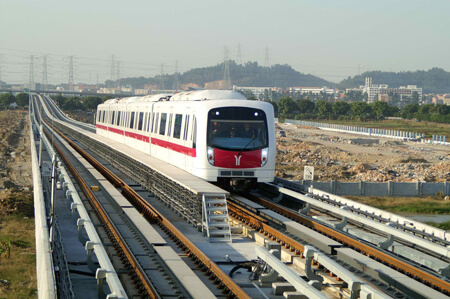
Johnston claims that we have used “raw construction costs” that don’t include the cost of rolling stock and signalling, and that the same “raw” costs for an on-street LRT system would be approximately $6 million per kilometre.
These assertions that our numbers are only for “raw construction costs” are entirely baseless—but what’s worse is that the Rail for the Valley group’s own cost comparisons are even more egregious than what he claims for us. This is because Rail for the Valley has long relied on “raw construction costs” for rural TramTrain corridors—not urban rail transit that is built and integrated into a city street.
As an example, Johnston says that:
And yet, according to this exact study, that “full build” capital cost of $7.2 million/per kilometre would essentially allow only for the provision of a single LRV train carrying between 120 and 240 passengers every 20 or 30 minutes. That’s a gross underestimation of the kind of service that would be needed for any urban rail rapid transit system in Surrey.[4]
It’s important to point out that building a basic rail service on the interurban rail corridor (a clear and pre-existing right of way) would be dwarfed by the actual costs to build an urban LRT on a city street. In reality, an urban LRT in Surrey would require:
When compared fairly, elevated SkyTrain in Surrey would cost only modestly more per kilometre while delivering far higher performance.
Finally, Johnston asserts that there is “overwhelming evidence that modern LRT is faster than, attracts more ridership than, and is cheaper to build than SkyTrain.” And yet, Johnston failed to provide any of that evidence in his response that this is true.
In reality, so much evidence exists to the contrary—as several light rail systems in North America have actually failed to attract ridership and a change of travel mode. Surrey residents should by now be familiar with the Portland MAX light rail system (which actually inspired the City of Surrey’s own push for LRT). We’ve found several sources that state the LRT lines there have consistently been failing to meet ridership projections and have not reduced driving in the greater Portland area[5][6]. That lower ridership might be attributed to the MAX’s slower average speed of just 34.1 km/h[7], as opposed to SkyTrain’s much higher 45 km/h.
A second example we want to point to is Dallas, Texas’s DART light rail system. In Dallas, the construction of 118 kilometres of DART Light Rail has put the city in a state of financial distress. DART says that on average, about 75,000 people make use of the 118km system each day[8] (compare that to Vancouver’s nearly 300,000 people per day), and there are now fewer riders on the DART today compared to when it was first opened[9]. The inefficiency of Dallas’s light rail system has led to higher bus fares, reduced overall service and fewer bus riders—even though bus riders continue to be the backbone of transit ridership.[9]
Surrey is one of Canada’s fastest-growing cities—and it needs a transit solution based on evidence, not assumptions.
Malcolm Johnston says that it is “sad to see the same old dated rhetoric trundled out by the SkyTrain lobby”—but his arguments rely on misused terminology, incomparable cost figures, and examples that do not reflect Surrey’s needs or conditions.
Automated rapid transit (SkyTrain) remains the option best aligned with Surrey’s long‑term growth, reliability requirements, and corridor constraints—and the public deserves a debate grounded in accurate, project‑specific information.
Pictured in header: Dallas DART light rail at railway crossing
Dear Editor,
A recent letter from Mr. Cruz, (skytrainforsurrey.org) is full of dated and misleading misinformation, so common with the SkyTrain lobby.
Only seven SkyTrain-type systems have been built since it was first marketed in the late 1970s, compared with well over 100 new light rail systems built during the same period. Why?
Modern light rapid transit (LRT) improves service on routes which it operates, bringing a quality transit service to former bus routes.
SkyTrain is a proprietary mini-metro system and if Bombardier Inc. (the present owner) decides to cease production, we would lose our only supplier. No one else builds SkyTrain, unlike modern LRT, which has many suppliers – including Bombardier Inc.
What many people do not realize is that SkyTrain was too expensive for the Canada Line and a cheaper, generic, grade-separated, electric multiple unit transit system was built instead. The Canada Line is not compatible to operate with the rest of the SkyTrain system.
Speed of LRT is dependent on the quality of rights-of-ways it operates on and the number of stations per route kilometre. LRT operating on a reserved right-of-ways (which can be a simple as a HOV lane with rails) can obtain commercial speeds equal of that of SkyTrain; LRT operating as a TramTrain on railway lines can obtain higher commercial speeds than SkyTrain.
Mr. Cruz, quoting “raw” construction costs, which excludes the cost of cars, signalling and power supplies for the Expo Line in Surrey, is again misleading as the same “raw” costs for LRT operating on-street is about $6 million/km.
The Rail for the Valley group, which engaged Leewood Projects from the UK to plan for a Fraser Valley TramTrain service using the old interurban route, found that the full build, 138 kms from Vancouver/Richmond to Rosedale worked out to $7.2 million/km. Modern LRT is affordable if it is designed to be affordable.
It sad to see the same old dated rhetoric trundled out by the SkyTrain lobby, especially today when there is such overwhelming evidence that modern LRT is faster than, attracts more ridership than, and is cheaper to build than SkyTrain.
Malcolm Johnston
Rail for the Valley
© Copyright (c) Surrey Leader, Nov 03 2011; Original URL:
http://www.surreyleader.com/opinion/letters/133117003.html
Reality Check
Reality Check is the online blog run by the founder of SkyTrain for Surrey, a BC-based community organization that has advocated for the expansion of the Vancouer SkyTrain system, including our successful advocacy for the under-construction Surrey Langley SkyTrain extension.
Media Contact: Daryl Dela Cruz – Founder, SkyTrain for Surrey ・ Phone: +1 604 329 3529, [email protected]