 SkyTrain for Surrey press team
MAYOR LOCKE’S CLAIM THAT SKYTRAIN TO SOUTH SURREY WOULD COST “OVER $8 BILLION” IS NOT GROUNDED IN REALITY.
Every few years, someone throws out a big, scary number about the cost of future SkyTrain expansion—and this year, that number was $8 billion. Mayor Locke’s statement reads like a warning, framing the idea of a future SkyTrain as unrealistic before the project has even been defined.
But here’s the reality: no one actually knows what a South Surrey SkyTrain extension would cost yet. Not because it’s unaffordable, but because it hasn’t been studied—whether by TransLink or the province. There is no finalized route, no design, and no engineering work to base a price on, so saying this future SkyTrain is “cost‑prohibitive” or claiming it would take “two decades” to build is not just premature—it’s irresponsible.
We’ve seen this pattern before.
In the early 2000s, the then-proposed Canada Line was subject to heavy scrutiny. Critics called the project “prohibitively expensive”; local leaders in other municipalities repeatedly voted to stall it; and some groups pushed for it to be converted to a surface LRT—including Richmond City Council, led by then mayor Malcom Brodie. It took the intervention of SkyTrain advocates, who called on the City of Richmond to hold a referendum, to keep an elevated line on the table—and on March 9, 2004, the finished public consultation drew a record response. Out of more than 13,000 respondents, the majority voted in favour of an elevated, grade-separated line over an at-grade LRT system.
Although Mayor Brodie and Richmond Council continued to stubbornly push for an at-grade system, TransLink and regional planners realized they had to respect the wishes of the people. So they sought a private partner who innovated to keep the elevated design, converted Mayor Brodie’s “no” vote into a “yes”, and eventually delivered the grade-separated Canada Line we know and love—on time and on budget.
Today, the Canada Line has become a national and international model for good public transit, inspiring projects like Montréal’s REM, which is opening a brand‑new 14‑kilometre extension to the West Island this weekend.
The Canada Line story shows how misleading early assumptions can be, and why it’s important to separate political messaging from actual project planning. Costs don’t come from speeches; they come from engineering, design choices, procurement models, and lessons learned from recent builds. And on all of those fronts, Surrey is in a far stronger position today than critics would have you believe.
To understand why the $8 billion figure doesn’t hold up, it helps to look at the fundamentals. Here are five key reasons a South Surrey SkyTrain extension is far more realistic—and far more affordable—than the mayor suggests:
#1: If a South Surrey SkyTrain were being built at the cost of the SLS today, it would cost only about $7 billion.
Using the Surrey Langley SkyTrain cost of $375 million per kilometre as a benchmark puts the 19-kilometre project cost closer to $7 billion. That’s not small—but it’s also not $8 billion!
And even this estimate assumes the South Surrey line would mirror SLS’s most expensive requirements: Expo Line infrastructure, long 80-metre platforms, and full system integration. But a future line doesn’t have to be built this way.
#2: The first phase to Newton would not require an OMC.
Although TransLink has not studied the full route to South Surrey, TransLink did study an Expo Line extension as far as Newton Centre in 2012 (with the cost estimates updated in 2019). This study noted that the short 5.5-kilometre extension would not require a new operations and maintenance centre (OMC)—dramatically reducing the costs by removing land acquisition requirements.
This was also long before we knew there would be OMC #4 in Coquitlam—and before we approved the SLS, which comes with OMC #5. Both of these OMC facilities should ensure that an OMC is not necessary for the first phase of King George Boulevard SkyTrain.
#3: The line does not have to follow the Expo Line’s infrastructure requirements or platform lengths
Nobody said that the future line has to be an extension of the Expo Line. As we discussed in our previous post, Two Ways to Build SkyTrain on King George Boulevard, a separate line with different design standards could be built for far less. This includes shorter platforms, because the line wouldn’t need to handle 5-car-long Expo Line trains (and the trains can be made wider to compensate).
#4: The current BRT project will reduce the cost of the SkyTrain.
Every dollar spent on the King George BRT is a dollar that won’t need to be spent later on SkyTrain. That’s because BRT construction includes utility relocations, land acquisition, street reconstruction, and corridor widening. All of this work would otherwise be bundled into the SkyTrain budget—at a higher and inflated cost, and with greater disruption.
Surrey residents should be familiar with this: before Surrey Langley SkyTrain construction reached Green Timbers Forest, Fraser Highway was widened there from 2 to 4 lanes. Today, while the Surrey Sprinter launch gantry and work crews work on the guideway above, the two outer lanes below are kept open for traffic. The alternative would have been a full closure of Fraser Highway through Green Timbers for multiple years, sending transit buses and cars through local neighbourhood streets like 92 Avenue.
Similarly, when the region’s first BRT (the 98 B-Line) was constructed on No. 3 Road in Richmond, the work done for it was critical for enabling the Canada Line. Before the BRT, No. 3 Road was a narrow 4-lane road with a centre turn lane, with malls and shops coming up to the sidewalk; there was no space to build a SkyTrain. Although the BRT was there for only 5 years before Canada Line construction began, the alternative would have been catastrophic: a fully closed road, shutting down businesses and severing the lifeline of the city.
#5: Integration with a larger regional or intercity rail project could make the SkyTrain essentially free.
That’s right, free!
Groups like Mountain Valley Institute and experts like Reece Martin have often pointed out that much larger projects could include urban rapid transit in Surrey, including proposed high-speed rail to Seattle and Portland, and regional rail connecting the Fraser Valley (Abbotsford-Chilliwack) and Sea-to-Sky (Whistler-Squamish) regions to Greater Vancouver.
Large‑scale nation-building rail projects often incorporate local rapid transit infrastructure as part of their corridor design. This is common worldwide—and it could happen here. If a future regional or high‑speed rail line uses the King George corridor, the incremental cost of building the local SkyTrain component could be minimal or effectively zero.
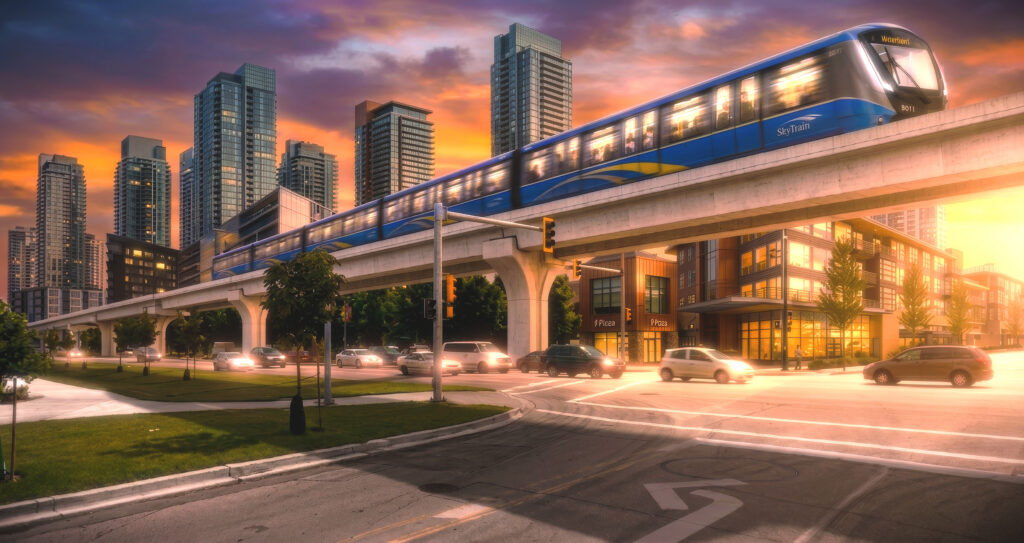
Pictured in header: Surrey Langley SkyTrain construction at Fraser Highway and 148 Street

SkyTrain for Surrey is a BC-based community organization that has advocated for the expansion of the Vancouver SkyTrain system, including our successful advocacy for the under-construction Surrey-Langley SkyTrain extension.
Media Contact: Daryl Dela Cruz – Founder, SkyTrain for Surrey ・ Phone: +1 604 329 3529, [email protected]