
I came across an interesting Metro Vancouver document on the South Fraser Blog that shows how many counted vehicles are registered in a given Lower Mainland city in a year, and associated patterns:
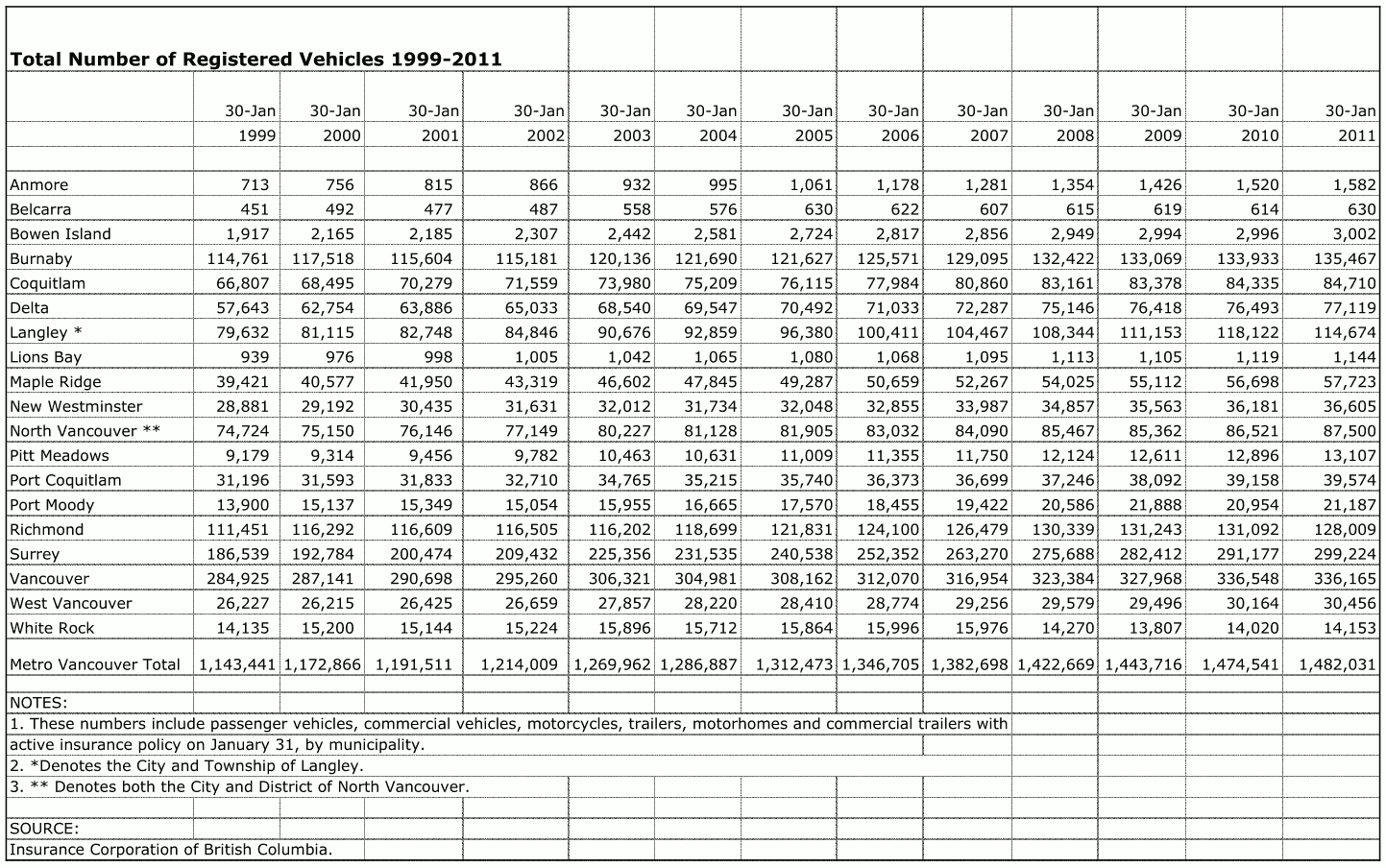
This chart shows various interesting trends in transportation choices being made throughout the Lower Mainland. In particular, in cities where SkyTrain lines were recently introduced, the number of vehicle registrations either slowed down or reversed.
This is especially happening in Richmond as a result of the opening of the Canada Line. Whereas consecutive increases were being recorded prior to the line’s 2009 opening, they then began dropping afterwards. Surveys of riders have recently shown that there are riders who choose to ride the Canada Line over driving, and that most riders value the speed, frequency and reliability of the service.
But perhaps an even more interesting trend might be the one that can be seen in Surrey.
Of the additional 338,590 vehicles registered in our region between 1999 and 2011, more than one third were registered in Surrey.
Generally, the largest gains in vehicle registration counts have been recorded in Surrey, as more and more people are choosing to drive. In 10 years, the difference between Surrey and Vancouver’s vehicle registration counts narrowed from 90,000 to 36,000 vehicles, and it is likely that Surrey’s count will soon surpass Vancouver’s.
The one-year period between January 2010 and January 2011 defines Surrey’s challenge of being a fast-growing city with a need for increased transportation facilities. Vehicle registration counts rose by 2.7% during this one year in Surrey, and no other city recorded any gains this high. In fact, the next highest gain in a larger city is that of Burnaby’s, which by percentage was a gain of only 1.1%.
In just over 10 years, Surrey saw a 50% increase in the number of vehicles—a total of 150,000 additional vehicles.
The data clearly shows that new generations of Surrey citizens, whether new drivers or new immigrants, are choosing to drive.
People are frustrated over the lack of competitive transit options in Surrey; in many cases, a 10 to 20 minute drive would require nearly 1 hour by our current transit services.
The unfortunate reality is that only 6% of Surrey residents are using transit—and most certainly, many are not using it for trips within Surrey. Such a low rate not only impacts the city as a whole, in that roads are seeing higher traffic counts and congestion than ever before, but it also impacts TransLink’s ability to provide good transit service in Surrey.
With so few people in our city taking transit, it can be expensive in that more subsidies (as opposed to fare revenue) are required to pay for the operation of these bus services. With rapid transit, there is an opportunity to attract ridership and reduce these costs; but, in Surrey, the right implementation type must be chosen, and the new rapid transit must be competitive with driving.
There is clearly a need for rapid transit to service Surrey’s busiest corridors, in order to encourage a largely automobile-oriented population to take transit. Right now, Surrey’s roads—servicing lower densities—have relatively low congestion rates and fast average speeds, which encourages more driving. This is evidenced by this map of collected data of transit route speeds published on Voony’s Blog:

(Note that this map and the data used to create it appear to have been from before the introduction of the Canada Line to Richmond)
The fastest services on average in Metro Vancouver are clearly defined: the SkyTrain, the non-stop West Coast Express, and non-stop bus services—especially those running on highways and expressways. Not surprisingly, where capacity is provided, and commute patterns fit, these services also observe the highest ridership counts of all routes in Metro Vancouver.
We are often concerned by whether light rail would be able to provide what Surrey needs: a competitive, economic transit service. However, with the 60km/h speed limits that all trains must obey on Surrey city streets, an on-street light rail service might just not be able to do that.