You can spend years researching transit in Metro Vancouver and still get key facts completely wrong.
Yesterday morning, I emailed Liz James, a weekly columnist at the North Shore News. In her latest column, she urged the newly appointed Auditor General to audit TransLink and proposed SkyTrain projects, arguing that there is a “TransLink‑manipulated comparative cost debate over SkyTrain versus LRT technology” and warning of “billions in capital and debt‑servicing costs.”
I asked what research supported those claims because I suspected she relied on sources I’ve found to be inaccurate. In our email exchange, one specific assertion she made that caught my attention concerned the Canada Line’s capital costs:
As for capital cost claims – the Canada Line was touted at $1.4 billion and ended up being over 2.1 billion before debt servicing costs were factored into the equation.
My organization (SkyTrain for Surrey) is no stranger to the Canada Line’s peculiar financing arrangements; we documented them in our Examining Canada Line History post. With that background, it was immediately clear to me that her claim appeared to conflate the public sector’s $1.4 billion funding commitment with the project’s final accounting of $2.1 billion, which includes private-sector contributions.
However, that clarification is not the main point. The more important issue is the claim that debt‑servicing costs must still be “factored” into the equation—as if those costs aren’t already part of the project accounting.
I’ve seen the same line of argument repeatedly, going back at least to the early 2000s:
The original SkyTrain from Waterfront Centre to King George Station in Surrey, including the rolling stock, cost $1.23 billion, not including debt-servicing costs.
SkyTrain gathers speed despite cost to taxpayers — Charlie Smith on the Georgia Straight, February 15, 2001
And more recently, Malcolm Johnston of Rail for the Valley has made similar claims:
…but TransLink doesn’t incl use debt servicing charges with their accounting methods and ignores the province’s now $250 million annual subsidy paid to SkyTrain.
Occupy TransLink and rid ourselves of the SkyTrain cult! — Malcolm Johnston on Rail for the Valley blog, October 20, 2011
…determined the real cost of the Canada Line mini-metro, which according to Chris’s research, is at least $4.5 billion, which does not include debt servicing on the provincial portion of the costs.
TransLink Menace to Society in Metro Vancouver— Malcolm Johnston on Rail for the Valley, February 22, 2012
Debt servicing is simply the cash required over a period to repay interest and principal on a loan. Financial references define it simply as the periodic payments of principal and interest on long‑term debt.
When a large capital project in our province needs funding—whether a transit line or any other major construction project—governments rarely pay from cash reserves. They borrow to finance construction and then repay those loans over time through debt servicing. For major projects, repayments are spread over many years through amortization, the scheduled repayment of principal and interest over the life of the loan. And, just as timely credit‑card payments affect personal credit, timely debt servicing affects government credit ratings.
What debt servicing is not is a hidden extra that makes infrastructure projects cost more than they should; it is simply the mechanism by which the original capital financing is repaid.
That misunderstanding can be dangerous because it can be exaggerated into wildly misleading claims. For example, Malcolm Johnston argues that hidden debt servicing has pushed SkyTrain’s total capital costs to over $8 billion:
Today, we have spent over $8 billion (those pesky debt servicing charges and retrofitting costs do add up) on a SkyTrain network…
War on Buses? Er…No, Just Very Bad Planning – Malcolm Johnston on Rail for the Valley blog, August 3, 2012
An example of how this plays out for our SkyTrain system can be found in TransLink’s financial reports. The 2011 report shows an amortization payment to the Canada Line’s private concessionaire partner (InTransitBC) of about $23.3 million for that year.[1]
Those payments are repaying roughly $700 million in private‑sector financing provided by InTransitBC, amortized over the 30‑year concession, which was part of the project’s public-private partnership (P3). Combined with the public sector’s $1.4 billion in committed funding, that private financing helps explain the commonly cited $2.1 billion total capital figure to build the Canada Line train.
That annual amortization payment will likely rise over time as inflation and interest accumulate, and future TransLink reports will reflect those changes. It’s fair to say the project ends up costing more over time once financing charges are included, but that increase must be weighed against the benefits—notably that the Canada Line was delivered on time for the 2010 Olympics—and the risk that other construction contractors with different designs for the system might not have done better on costs or delivery timeline.
It’s also important to note that TransLink had no SkyTrain capital‑debt responsibility before the Canada Line. When TransLink was formed, the province agreed to retain the debt associated with the original SkyTrain projects—and later agreed to do the same for the Millennium Line[2]. This is the first time TransLink’s balance sheet has been used to service SkyTrain capital debt. That history can create the impression that earlier SkyTrain debt servicing was hidden, but the province does report those costs publicly in separate reports.[3]
One final example I can draw from is in Charlie Smith’s article I referenced earlier: after he noted that some debt‑servicing costs appeared not “included,” he offered readers an idea of what those costs were for our original SkyTrain Expo Line (and with a source, unlike Malcolm Johnston):
According to a 1998 GVRD consultant’s report, the SkyTrain debt-servicing costs alone for 1997-98 were $143.3 million.
SkyTrain gathers speed despite cost to taxpayers — Charlie Smith on the Georgia Straight, February 15, 2001
Charlie Smith’s point—that readers deserve transparency on what is being paid into our SkyTrain system—is reasonable. Yet from his reporting here, we learn only the debt‑servicing amount for a single financial year. We still don’t see the other basic numbers that matter: the total principal outstanding, how far along the repayments are, or even what interest rates were applied. That absence of clarity is precisely what allows the phrase “debt‑servicing” to be misused in broader attacks on SkyTrain costs.
Right now, I fear that many people in the transit advocacy sphere may become confused about what “debt servicing” actually means—including how it works, and why governments use it. Increasingly, I see debt servicing being framed by LRT advocates as a kind of “hidden cost,” as if it were an extra expense that planners have somehow failed to include from discussions about transit expansion.
So let me ask plainly: If there are supposedly hidden debt servicing costs attached to SkyTrain expansion projects—costs that exist in addition to the capital budget—then what is the hidden debt that’s being serviced?
The truth is that there is no separate, mysterious liability waiting to be revealed—and when LRT advocates invoke phrases like “not including debt servicing” or imply that costs have been concealed, what they often reveal is not a hidden accounting trick—and perhaps not even their own ignorance—but a willingness to use misleading language to score points in the SkyTrain vs. LRT debate.
These claims deserve careful scrutiny. Anyone interested in Metro Vancouver transit should take a second look before accepting debt-servicing arguments from light rail proponents at face value.
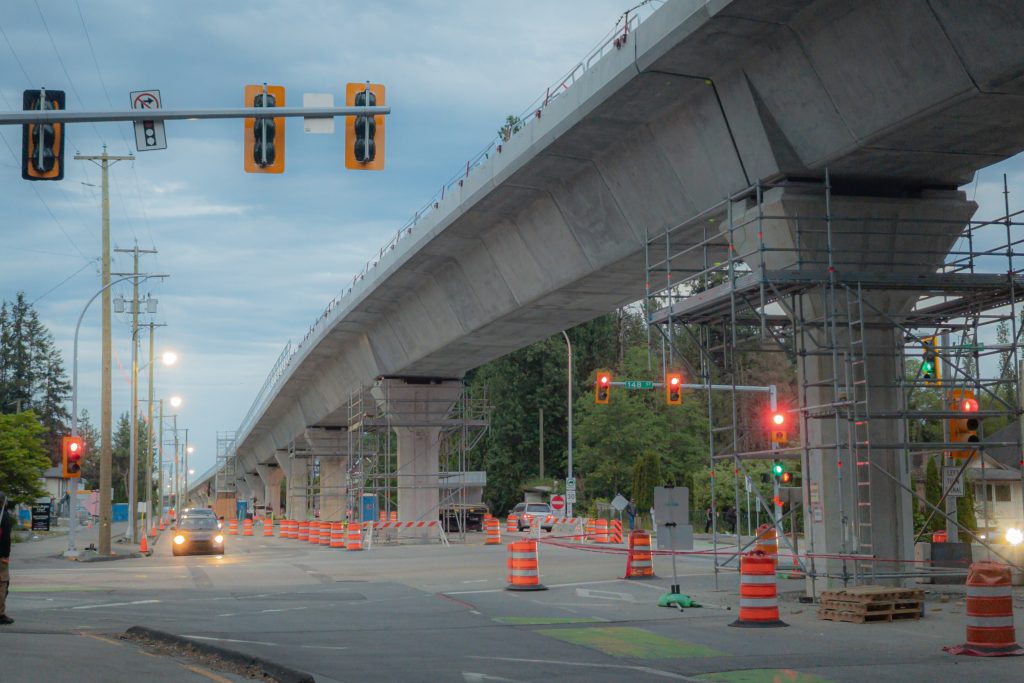
Pictured in header: Millennium Line SkyTrain at VCC-Clark Station
Reality Check
Reality Check is the online blog run by the founder of SkyTrain for Surrey, a BC-based community organization that has advocated for the expansion of the Vancouver SkyTrain system, including our successful advocacy for the under-construction Surrey-Langley SkyTrain extension.
Media Contact: Daryl Dela Cruz – Founder, SkyTrain for Surrey ・ Phone: +1 604 329 3529, [email protected]
We use cookies to improve your experience on our site. By using our site, you consent to cookies.
Manage your cookie preferences below:
Essential cookies enable basic functions and are necessary for the proper function of the website.
Statistics cookies collect information anonymously. This information helps us understand how visitors use our website.
Google Analytics is a powerful tool that tracks and analyzes website traffic for informed marketing decisions.
Service URL: policies.google.com (opens in a new window)
You can find more information in our Cookie Policy and .