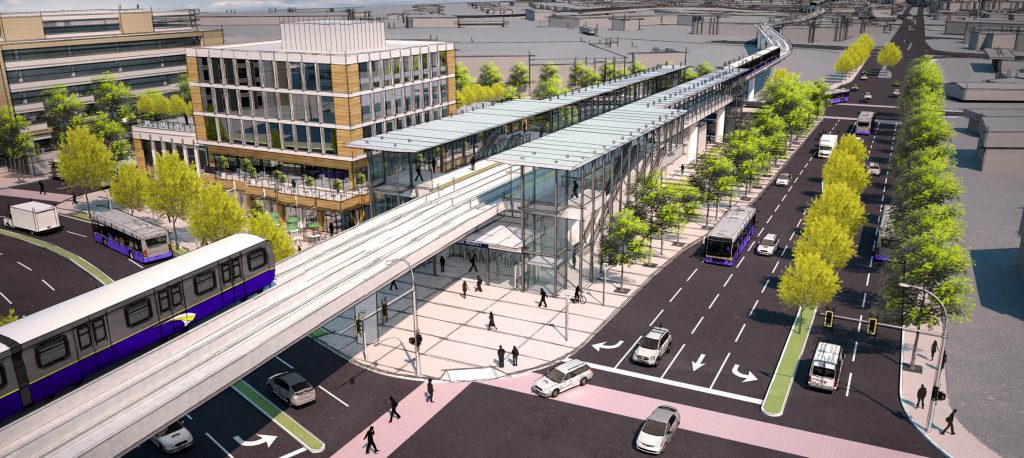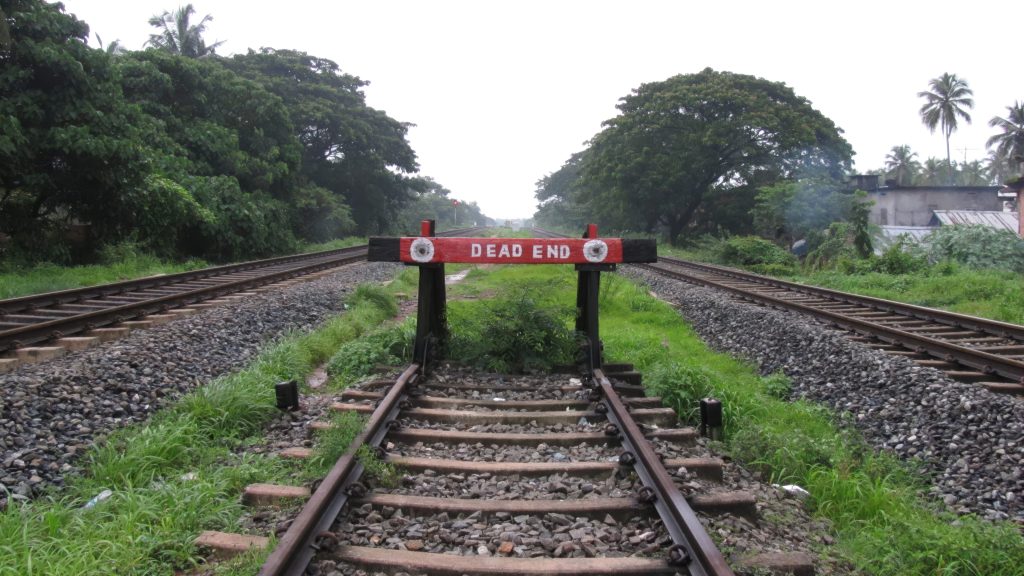

Surrey has admitted in a recent City report that the proposed Surrey-Newton-Guildford LRT line will create massive and unmanageable congestion on city streets throughout Guildford.
A recent corporate report that has recommended the construction of 105 Avenue (Surrey’s proposed roadway through Hawthorne Park) has also made note of the potential traffic impacts of a street-level LRT line on 104 Avenue. According to this report, more than 74,000 vehicles per day (vpd) utilize the three east-west corridors (100 Ave, 104 Ave and 108 Ave) connecting Surrey City Centre and Guildford. 104 Avenue, which links City Centre with the Trans Canada Highway, carries 32,000 vpd and is the busiest of the 3 corridors.
If LRT construction proceeds on 104th Avenue, the loss of 2 traffic lanes to accommodate LRT will induce diversions of up to 50% of existing 104 Ave traffic onto 100 and 108 Avenues, straining these already busy roadways with thousands of additional vehicles each day.
104 Avenue would be unable to accommodate the remaining 16,000 vpd in traffic volume “without significant delays and queueing”.

Surrey claims that proceeding with the construction of a 105 Avenue corridor will offset some local traffic and result in “acceptable levels of congestion” on 104 Avenue, reinforcing our earlier findings that the proposed LRT is the only reason for building this roadway. However, the report notes that despite both “growth in ridership” on the LRT line and 105 Ave in place, the parallel 100th and 108th Avenue corridors will be “approaching capacity” by 2030—just 7 years after LRT operation is expected to begin.

This indicates that no matter what is the outcome of the alternative approval process that decides if 105 Avenue connector is built, all east-west corridors between Surrey City Centre and Guildford will be subject to heavy congestion at peak times if LRT on 104 Avenue is built.
This also means that further investments in road expansion and property expropriation may be necessary in the future in order to manage road congestion caused by LRT—burdening city taxpayers as millions of dollars will be required from city funds in order to pay for these projects.

Despite these costs and these impacts, LRT is expected to deliver only 1 minute in travel time savings between Guildford and Surrey City Centre compared to existing B-Line and express buses.
The added congestion from an LRT will significantly increase the travel times of the #320 bus that will continue to make local stops using the general traffic lanes.
LRT operations will also likely result in the cancellation of through-running express buses such as the 337 to Fraser Heights (which offers a fast, non-stop service to Surrey Central) and the 501 and 509 buses to Walnut Grove. These buses’ riders will be forced to transfer to the LRT line at Guildford Exchange, increasing travel time to Surrey City Centre rather than decreasing it.
It is unacceptable for the billions of dollars that this LRT system will cost that transit service in Guildford will become only marginally better, even as the entire community becomes subjected to the massive congestion increase as a result of building the LRT.


 SkyTrain for Surrey has always suggested a Bus Rapid Transit or BRT system instead of LRT on the 104 Ave and King George corridors. BRT is a world-class transit system that can offer the comforts and features of a street-level Light Rail system for a fraction of the price.
BRT allows for supporting infrastructure to be phased in gradually. Our proposed system will construct median transit lanes immediately on King George Blvd, but defer the construction of these lanes on 104 Ave until adequate space is available to accommodate 2 dedicated transit lanes and 4 traffic lanes throughout the corridor.
Interim measures, such as traffic signal priority for buses, new right-turn lanes, and queue-jumper lanes, will significantly improve transit service reliability without reducing traffic capacity on the corridor
Through-running services could also connect Surrey City Centre with Coquitlam via the Port Mann Bridge, and Carvolth Exchange and the Fraser Valley via Highway 1, offering more opportunities to increase transit mode-share that would be missed by an LRT to only Guildford.

BRT has recently become a popular rapid transit alternative for Canadian cities. Winnipeg, York Region, London and Brampton are some of the many Canadian cities that have chosen BRT instead of light rail for a major transit project.