SkyTrain for Surrey

Surrey LRT line will be among slowest in Canada

SkyTrain for Surrey has learned that the low average travel speed of the Phase 1 Surrey-Newton-Guildford LRT line will make it one of the slowest rail transit systems in Canada.

According to the latest numbers released by the City of Surrey and TransLink, the Surrey-Newton-Guildford LRT line will offer an average commute speed of just 21.4 kilometres per hour after accounting for average wait times, which means that compared to existing and proposed rail transit systems in Canada, the first phase LRT line in Surrey will be significantly slower. The only projects that are planned to be slower will be the Finch West and Sheppard East LRTs in Toronto.

In comparison, almost all other Canadian LRT projects are designed to offer faster “rapid transit” speeds.[1]

Average speeds of proposed Light Rail lines in Canada
  • Calgary Green Line Stage 1 – 30.8 km/h
  • Ottawa Confederation Line – 29.4 km/h
  • Toronto Eglinton Crosstown LRT – 28.5 km/h
  • Edmonton Valley Line Southeast – 24.2 km/h
  • Hamilton B-Line LRT – 24.0 km/h
  • Waterloo Region ION LRT – 22.8 km/h
  • Surrey-Newton-Guildford LRT – 21.4 km/h

Why Surrey's LRT system is slower than other LRT systems

With a running right-of-way located entirely on city streets, crossing numerous major intersections, Light Rail Trains on Surrey’s LRT system will be limited to roadway speed limits of 50-60 km/h.

By comparison, most of the other LRT systems above offer considerable segments that are off of the street and in their own rights-of-way, where trains can travel at significantly faster speeds of 80-90 km/h, unimpeded by any obstructions or surrounding traffic. Many of these segments will be located on an elevated guideway or a tunnel, similar to SkyTrain, offering full grade-separation from the street level.

In fact, Canada’s three largest Light Rail projects – Toronto’s Eglinton Crosstown, Ottawa’s Confederation Line and Calgary’s Green Line – all feature long underground segments that are fully grade-separated from pedestrian and vehicle traffic. Fully grade-separated construction has been a common trend among modern LRT systems, including Canadian and U.S. cities such as Calgary and Seattle.

Existing TransLink bus routes outpace the Surrey LRT

With TransLink’s posting of average speeds in its most recent Transit Service performance review, we took the opportunity to rank the Surrey-Newton-Guildford LRT against other daytime bus routes in our transit system. Against these routes, the Surrey-Newton-Guildford LRT ranks 116 out of 192 routes, making it slower than the majority of the region’s existing bus routes.[2]

When compared specifically against busy routes on the frequent transit network, the Surrey-Newton-Guildford LRT is outperformed by several other bus routes such as the #100, #160, #250, #320, #321, and the #95 Hastings Street B-Line.

The SNG LRT Line ranks 18th among TransLink routes on the Frequent Transit Network (FTN). Note: numbers compared are “raw” average speeds that do not account for average wait times.

Our suggestion: Replace the SNG LRT with a SkyTrain toward Langley

SkyTrain for Surrey has called for the cancellation of the Surrey-Newton-Guildford LRT, in favour of the construction of a Bus Rapid Transit (BRT) system for a fraction of the cost on King George Boulevard and 104 Avenue, with significantly fewer negative community impacts. Funds freed up by cancelling SNG LRT can then accelerate a rapid transit line on Fraser Highway, built as an extension of the SkyTrain Expo Line.

We can have many LRT features for a fraction of the cost

SkyTrain for Surrey has suggested the construction of a Bus Rapid Transit system on 104th Avenue and King George Blvd, on which it is possible to incorporate many of the same features offered by LRT systems such as dedicated transit lanes, traffic signal priority, real-time “next bus” displays, off-board fare payment, and more.

See: 10 Surrey LRT features for a fraction of the cost

In 2012, TransLink’s Surrey Rapid Transit Study suggested that a Surrey-Newton-Guildford LRT would produce a negative return on investment, offer little to no travel time savings compared to existing transit, and increase congestion throughout the community. As a street-level line running through 27 major intersections, the Surrey-Newton-Guildford Line will be prone to frequent track closures caused by accidents, vehicle-train collisions, and other incidents, making transit less reliable than it is today.

Street-level Light Rail in Surrey will not reduce congestion, will not increase transit ridership, and will not offer legible transit improvements despite costing hundreds of millions of dollars. We do not want a transit system that is an expensive mistake.

Footnotes

  1. Dataset: LRT and rapid transit travel times in Canada — compiled by SkyTrain for Surrey founder Daryl Dela Cruz[↩]
  2. Dataset: Average speeds of TransLink bus and rail routes — compiled by SkyTrain for Surrey founder Daryl Dela Cruz, using 2017 Transit Service Performance Review (TSPR) data from TransLink[↩]

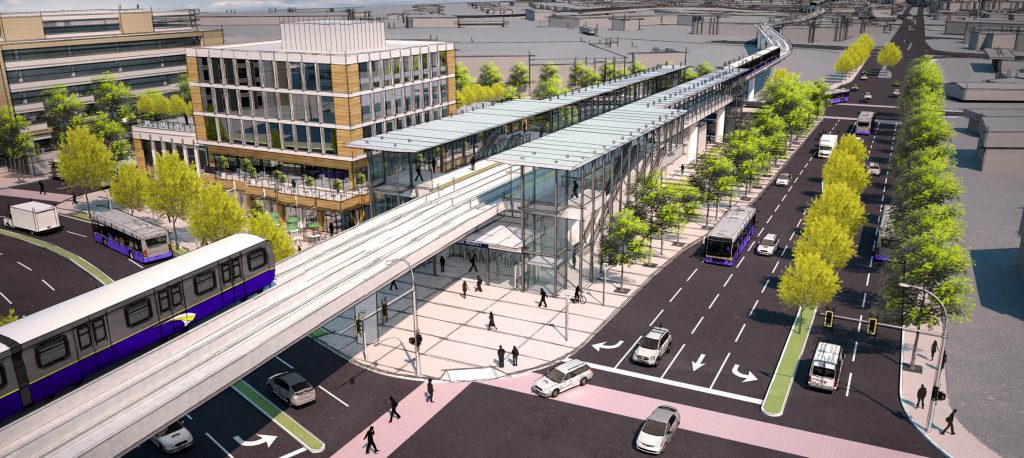
Pictured in header: Depiction of congestion on 104 Avenue corridor as a result of constructing the Surrey-Newton-Guildford LRT

SkyTrain for Surrey is a BC-based community organization that has advocated for expanding the Vancouver SkyTrain system, including our successful advocacy for the under-construction Surrey-Langley SkyTrain extension and the proposed SkyTrain expansion to Newton.

Media Contact: Daryl Dela Cruz ​– Founder, SkyTrain for Surrey ・ Phone: +1 604 329 3529, [email protected]

Surrey LRT line will be among slowest in Canada