 SkyTrain for Surrey press team
Over the years, many superfluous claims have circulated about why the Canada Line—known in planning as the Richmond–Airport–Vancouver Line or RAV Line—was not built with the same linear‑induction technology used on the Expo and Millennium Lines.
Public discussion often starts from the wrong premise: that the line’s technology was chosen simply because it was “cheaper”, or because SkyTrain’s linear‑induction system was somehow unsuitable. However, neither claim holds up to scrutiny.
In reality, the Canada Line’s design and technology were shaped by a competitive P3 procurement that evaluated complete system proposals, not isolated components. Much larger considerations were at play, and the winning bid was the one that best met the project’s actual priorities: risk transfer, schedule certainty, construction feasibility, and lifecycle value—all under tight funding caps and the immovable deadline of the 2010 Winter Olympics. To understand why the line looks the way it does, we need to look at the process that shaped it.
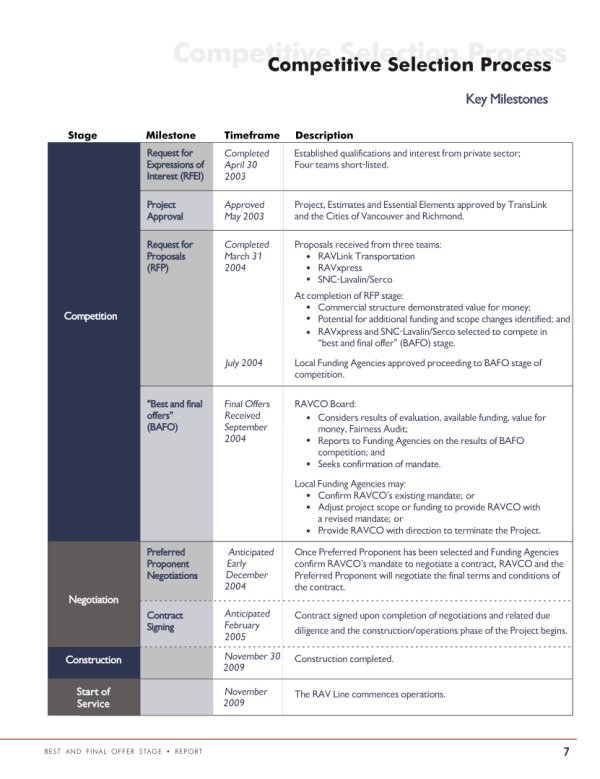
The Canada Line was procured as a Public–Private Partnership (P3) that evaluated whole-package bids—design, construction, financing, operations, and maintenance—rather than mandating a single vehicle technology.
This means that bidders—whether individually or in teams—would take part in the design process as well as the eventual construction, including the selection of vehicles and vehicle technology. They would also be responsible for providing their own expertise in setting up the ongoing operations and maintenance upon the completion of line construction.
The original Canada Line design processes started with a request for proposals document that was sent out to four earlier selected and short-listed proponents, who had responded to an earlier “Request for Expressions of Interest”[1]. These proponents were teams that may include some familiar names that supply design and/or rolling stock for rapid transit systems. They are:
These proponents had to meet several pre-determined specifications and rules set in the request for proposals. For example, the RFP backgrounder highlights that planners wanted the target cost (in the dollars of the time and according to the funding provisions of the time) to land between $1.5 and $1.7 billion.
Among the specifics was a deadline date, which would be later constrained by the cancellation[2] and revival[3] of the Canada Line project.
Evaluators tested operational simulations, cost models, and construction sequencing.
From multiple proposals, the process shortlisted two consortiums that offered contrasting but credible solutions: one aligned with the existing linear-induction SkyTrain technology, and one offering conventional electric multiple units (EMUs) with automated signalling.
Each proponent team then submitted two final base proposals: one fully grade-separated, and one with a surface LRT segment.
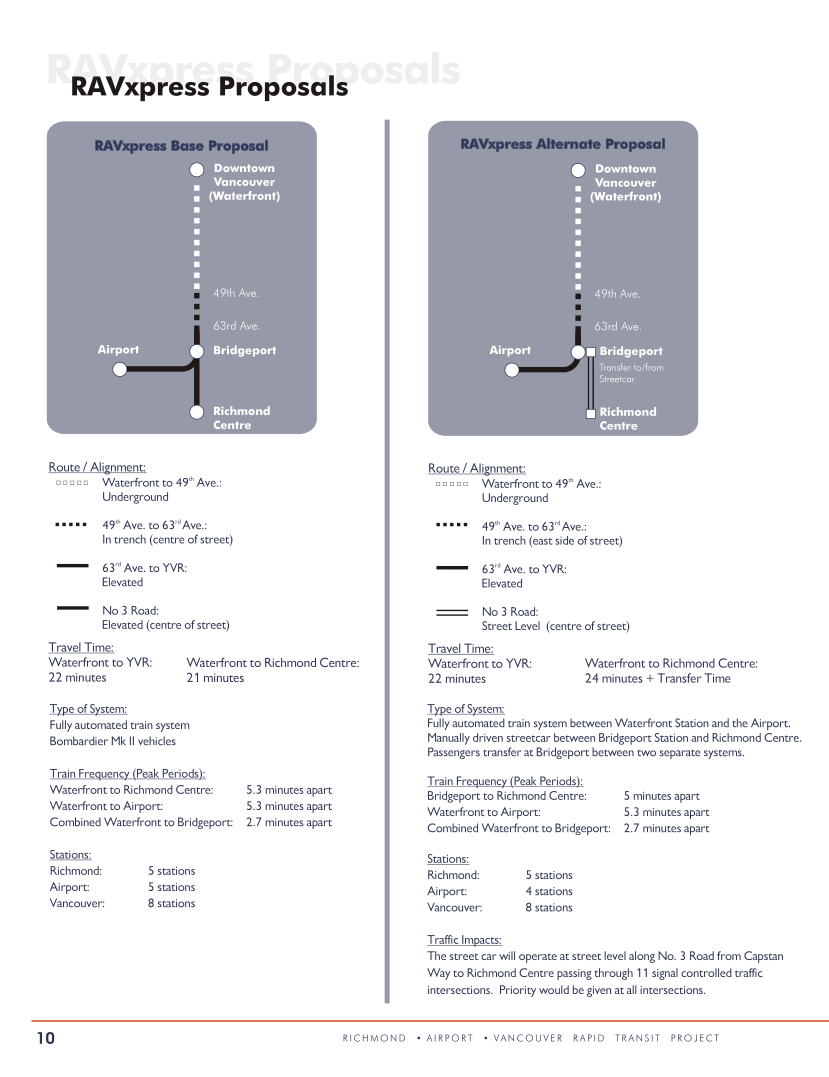
As the RAVxpress consortium included Bombardier, its recommendation involved continuing the use of the Expo and Millennium Lines’ linear induction motor technology—even though the line and its depot would not be connected to existing SkyTrain at all.
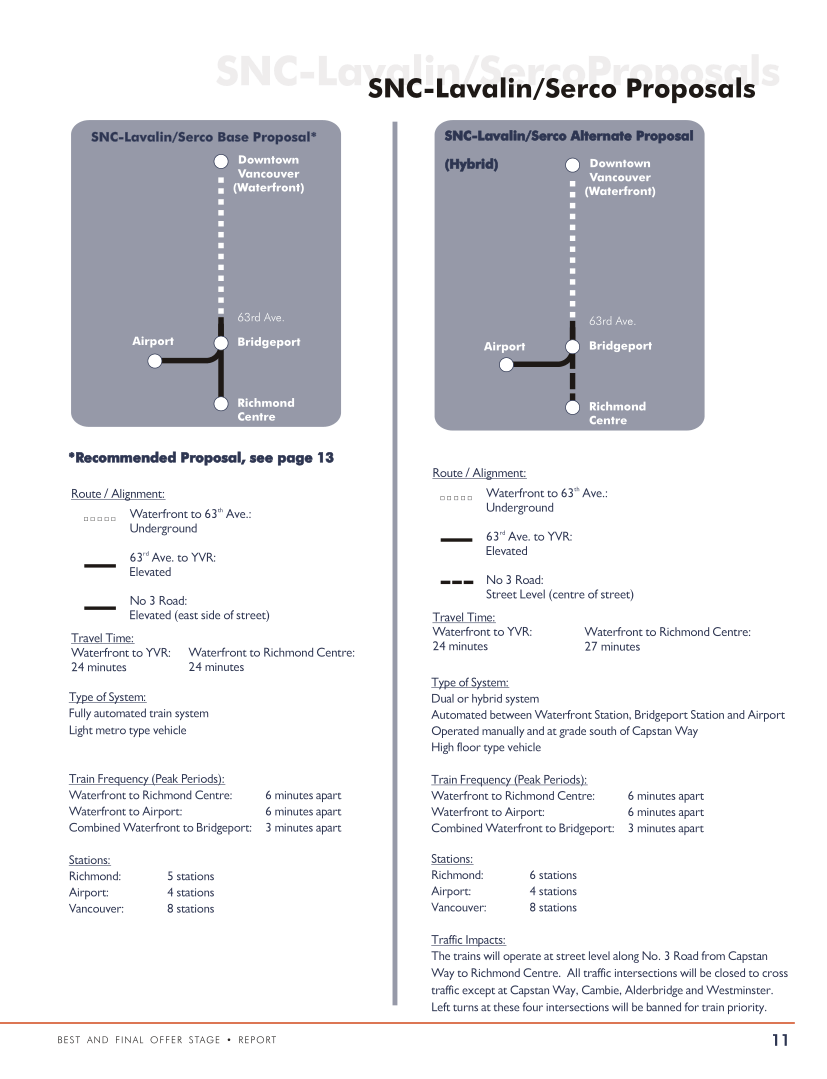
Meanwhile, the SNC-Lavalin/Serco consortium proposal just specified either a light metro vehicle or a high-floor light rail vehicle.
In the end, the CLCO (Canada Line Co., a subsidiary of TransLink) board selected SNC-Lavalin/Serco as the winning bidder, which would later form the InTransitBC partnership. Planners then later selected the fully grade-separated system over the proposed at-grade options[4], and the consortium then subsequently awarded a vehicle contract to Korea’s Hyundai Rotem after a bidding process.
Here is a summary of what factors likely influenced the decision:
Up to this point, the project criteria did not actually required grade separation, which is why both proponents provided both a fully grade-separated option and a second, partially at-grade option.
In the end, local input became instrumental in planners’ decision to make the Canada Line fully grade-separated, with no at-grade intersections. Richmond residents strongly preferred grade separation, and with the community not being receptive to having urban rail tracks run at-grade on No. 3 Road, the LRT option was eventually completely eliminated from further consideration.
It’s worth noting that proposals for at-grade systems were actually more expensive, as an at-grade system would have required more expensive trains capable of manual operation along No. 3 Road, whereas the grade-separated system could be fully automated like existing SkyTrain—reducing staffing requirements. Tunnels would have also needed to be taller to accommodate use of overhead wiring instead of third rail.
SNC-Lavalin/Serco estimated that the grade-separated option would save approximately $90 million over their hybrid at-grade proposal.
Canada Line opens ahead of schedule
Vancouver’s newest addition to the SkyTrain system, the Canada Line, will officially begin service on Monday, Aug. 17, more than three months earlier than originally scheduled and with a special treat for transit riders… (CBC News)
Canada Line exceeds ridership and revenue projections
Figures released by TransLink today show average weekday ridership exceeded 104,000 for three months in a row. In May, an average 104,682 people rode the Canada Line every Monday through Friday. In June, it hit 106,320 per day and July’s total was 107,198. Daily averages (for all seven days a week) were 94,223, 97,969 and 99,210 for the same three months. Original ridership projections forecast that the line would reach an average 100,000 passengers every day, including weekends, by 2013… (TransLink)
TransLink had originally expected to reach an average 100,000 passengers per day, including weekends, by 2013. But in the past three months, the average weekday ridership has exceeded 104,000. TransLink said ridership is also up during weekends. If the ridership keeps up this trend, TransLink expects the Canada Line will reach the break-even point — with passenger revenue covering its operating costs — three years earlier than planned, just as the Expo and Millennium lines did. (Vancouver Sun)
SNC-Lavalin wins technical innovation award for Vancouver’s Canada Line
Vancouver’s Canada Line rapid transit project has netted SNC-Lavalin Inc. top marks for technical innovation – the Schreyer Award – in the 2010 Canadian Consulting Engineering Awards program. (Journal of Commerce)
Canada Line transforming Richmond City Centre: $4+ billion in development
The current wave of development includes up to $4 billion in new development that is now under construction, being marketed or going through the planning approval process. It includes the largest single development project ever proposed for Richmond, as well as a significant number of proposed new hotel developments. (City of Richmond)
Pictured in header: A Canada Line train approaching
Reality Check
Reality Check is the online blog run by the founder of SkyTrain for Surrey, a BC-based community organization that has advocated for the expansion of the Vancouer SkyTrain system, including our successful advocacy for the under-construction Surrey Langley SkyTrain extension.
Media Contact: Daryl Dela Cruz – Founder, SkyTrain for Surrey ・ Phone: +1 604 329 3529, [email protected]