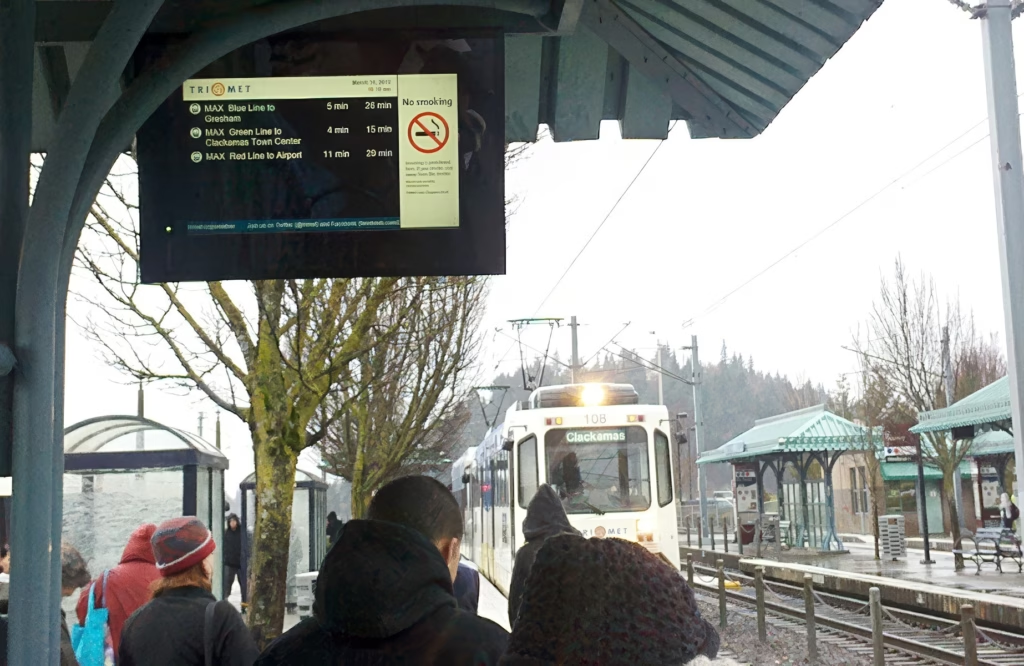
There needs to be an understanding of the role that rail transit will play in Surrey in the future: this city needs rail transit not only to move people who are here today more effectively, but also to accommodate population growth and encourage appropriate development in the right areas. As it turns out, Surrey’s recent push for light rail started after City Council visited Portland, Oregon in late 2010 or early 2011. Mayor Dianne Watts seems to be very intent on her consideration of Portland’s rail transit system as a role model for rail transit in Surrey. However, we would like to point out that her claim on economic development is very greatly exaggerated.
According to TriMet (the public transportation agency in Portland), the MAX light rail has brought approximately $8.2 billion in nearby transit-oriented development[1]; and according to Portland Streetcar Inc., the 6-kilometre downtown streetcar had attracted approximately $2.3 billion in development in the 9 years since planning began in 1997[2]. This combined figure of $10.5 billion is well short of the “$31 billion” figure that Mayor Watts claims.
But, what many people don’t know is that the majority of this $10.5 billion in development could not have been implemented without the spending of several billion dollars in tax waivers (subsidies), in order to attract the development onto the new line.
In 1996, a City Commissioner finally convinced the Portland City Council to start offering developers tax waivers for any high-density housing built near light rail stations; and while the development came, it came at a huge expense. An estimated $2 billion dollars of tax waivers (subsidies) were spent to attract transit-oriented development to MAX Light Rail lines by 2007: an average of $180 million every year.[3]
When Portland’s first light-rail line opened for business in 1986, the city zoned much of the land near light-rail stations for high-density development. Ten years later, city planner Mike Saba sadly reported to the Portland city council, “we have not seen any of the kind of development—of a mid-rise, higher-density, mixed-use, mixed-income type—that we would’ve liked to have seen” along the light-rail line.

There seems to be no guarantee that the people choosing to live in transit-oriented developments near the MAX LRT are actually making use of the light rail line as their primary choice for transportation.
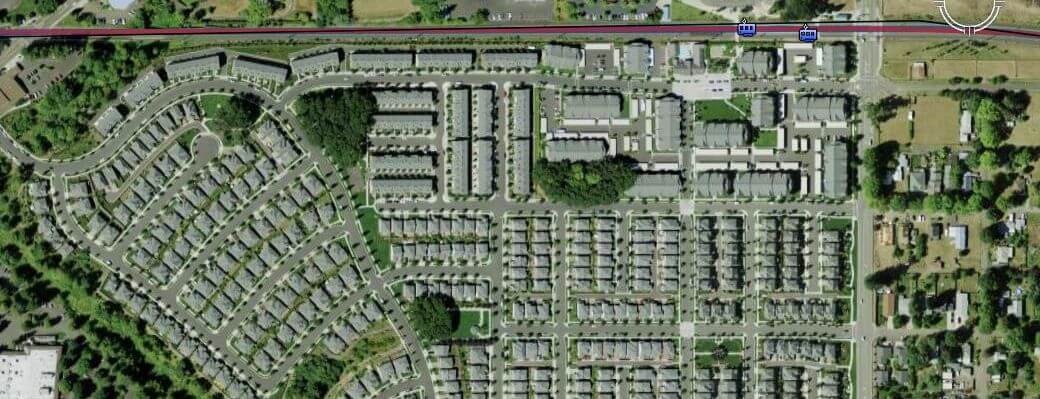
Nearly two-thirds of residents in the new transit-oriented Orenco neighbourhood (located west of Portland), built upon an adjacent MAX light rail station, list driving to work alone as their exclusive form of commute.
Orenco residents ranked last among the four neighbourhoods explored in a study on two other transit measurements: just 15 percent of them consider mass transit their exclusive commute mode, and just 9 percent ride it at least five times a week.[4]
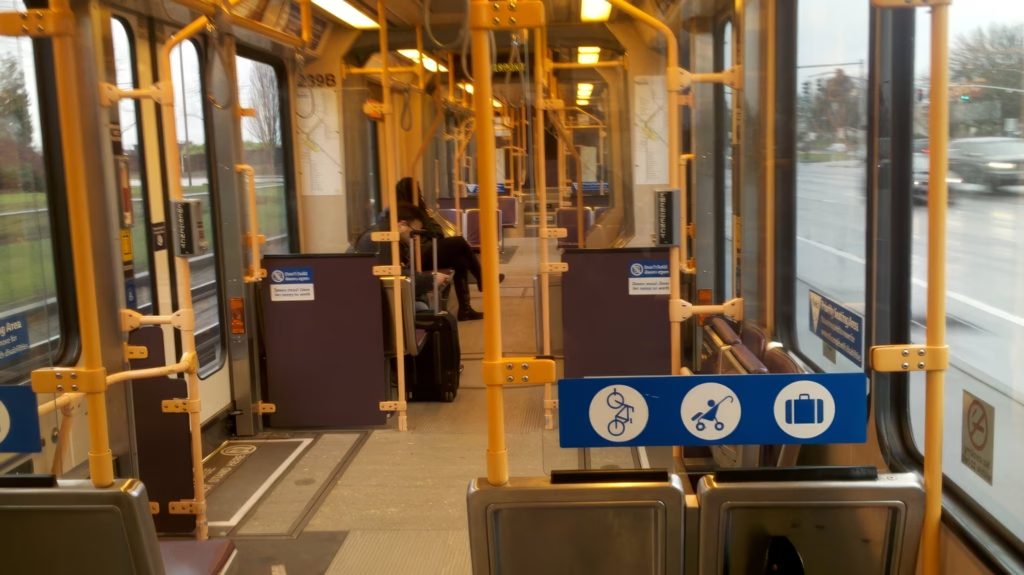
TriMet has built many large park-and-ride lots with ample free parking along all MAX lines, often rather than supporting its MAX LRT lines with an adequate local bus network (Perhaps the overall system’s low fare recovery ratio of about 36% could be blamed, as there are fewer funds to operate buses since light rail was introduced[5]). Yet despite all of this free parking, congestion levels along several Portland roads have not been reduced.
Even after the Eastside MAX light rail line opened in 1986, traffic counts on a nearby freeway had increased by as much as 23% by 1995[6][7], outpacing the county’s population growth[8]. In fact, traffic congestion in the Portland area continued to grow faster than other West Coast cities—including Seattle, which at the time had not yet introduced any rail transit system or its ST Express highway buses.
The MAX light rail currently operates at an average speed of approximately 31 kilometres per hour[9], which is simply not travel-time competitive with the automobile. For comparison, SkyTrain averages between 44 and 45 kilometres per hour.
Surrey is not Portland, and the MAX Light Rail cannot serve as a role model for such similar future implementation here. Portland does not have to integrate its rail transit system with rail transit systems in other neighbouring cities, something that Surrey has to do.
According to TransLink, 84 percent of trips today within Surrey and Langley involve use of an automobile, while only 8 percent use transit. This is a number that drastically needs to change for the better in the coming years: TransLink themselves are ambitiously aiming to reduce the automobile mode share to 50% by 2041.
Many primary roads in Surrey are operating over their designed capacity, so we need to ensure that a change in mode share is brought forward by the implementation of a competitive, reliable and successful rapid transit system.
Why should Portland’s Light Rail system, which has failed to do that, be a role model for rail transit expansion in Surrey?
Pictured in header: A MAX light rail train at an on-street station in downtown Portland
Reality Check
Reality Check is the online blog run by the founder of SkyTrain for Surrey, a BC-based community organization that has advocated for the expansion of the Vancouer SkyTrain system, including our successful advocacy for the under-construction Surrey Langley SkyTrain extension.
Media Contact: Daryl Dela Cruz – Founder, SkyTrain for Surrey ・ Phone: +1 604 329 3529, [email protected]